
 العربية
 Español
 中文
中文 Deutsch
 Français
 Português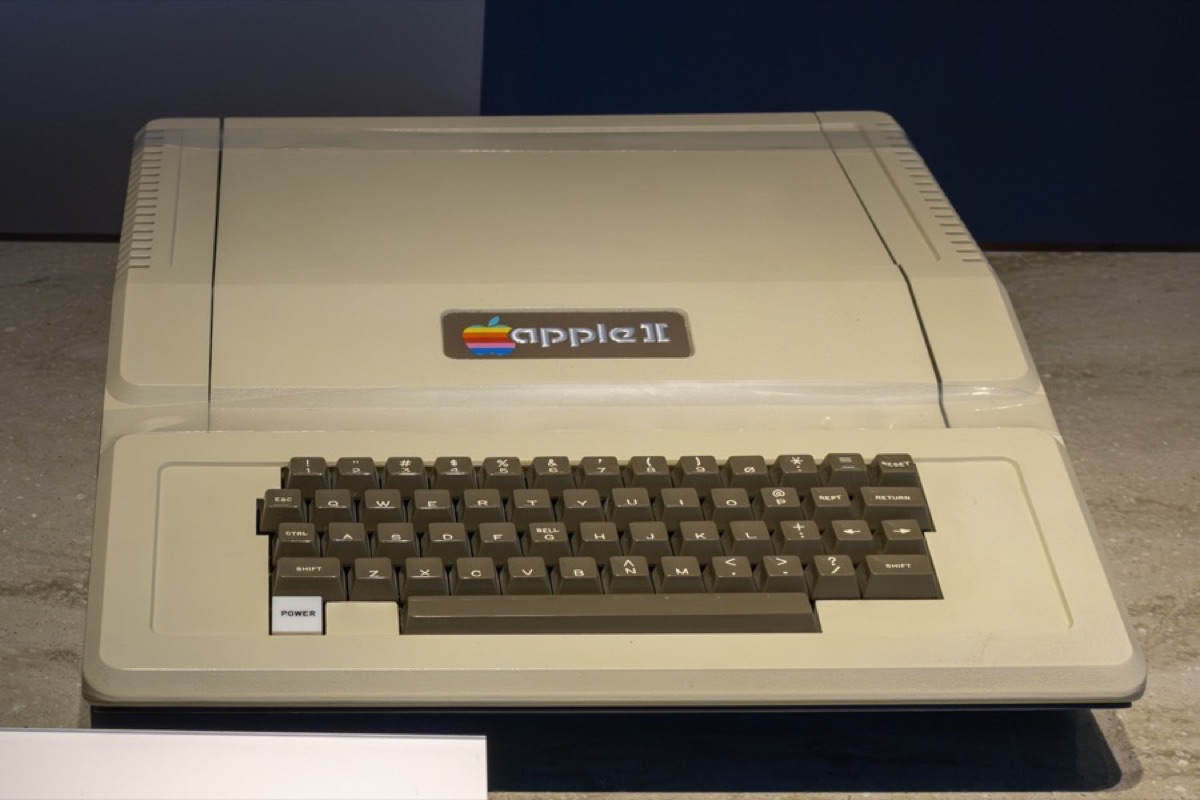
This is Part 2 of a 7-part series: "Apple at 50." Part 1 covered the garage founding, the Apple I, and Ronald Wayne’s $800 mistake. Now we witness the transformation from garage project to billion-dollar company.
By late 1976, Apple Computer Co. had sold about 175 Apple I boards and earned roughly $100,000 in revenue. Jobs and Wozniak were still working out of the family garage. The Apple I was a hobbyist’s circuit board. To become a real company, they needed three things: money, a real product, and adult supervision.
They got all three in the span of a few months.
1. The Angel Investor: Mike Markkula
In late 1976, Mike Markkula walked into the Jobs family garage. He was 33 years old, a former Intel engineer who had made a small fortune from Intel stock options and retired early. A mutual contact — Don Valentine of Sequoia Capital (who had passed on investing in Apple himself) — suggested Markkula take a look.
Markkula saw the Apple II prototype that Wozniak was developing. Unlike Valentine, who saw two scruffy kids in a garage, Markkula saw the future of personal computing.
| Contribution | Detail |
| Investment | $250,000 — a personal check of $91,000 plus a $250,000 line of credit from Bank of America |
| Business Plan | Wrote Apple’s first business plan, projecting $500 million in revenue within 10 years (most people thought this was insane) |
| Role | Employee #3, first Chairman of the Board, mentored both Jobs and Wozniak in business operations |
| Philosophy | Wrote "The Apple Marketing Philosophy" — three principles: Empathy (understand customers), Focus (eliminate distractions), Impute (people judge by presentation). These principles guided Apple for decades. |
Without Markkula, there is no Apple. He provided the money, the business expertise, and the credibility that Apple needed to attract engineers, retailers, and eventually Wall Street. His $250,000 projection of $500M revenue was wrong — Apple hit that number in half the time.
On January 3, 1977, Apple Computer Co. was incorporated, replacing the informal partnership. Jobs, Wozniak, and Markkula each received significant equity. Apple had its first real office: a suite at 20863 Stevens Creek Boulevard in Cupertino.
2. The Apple II: The Computer That Changed Everything
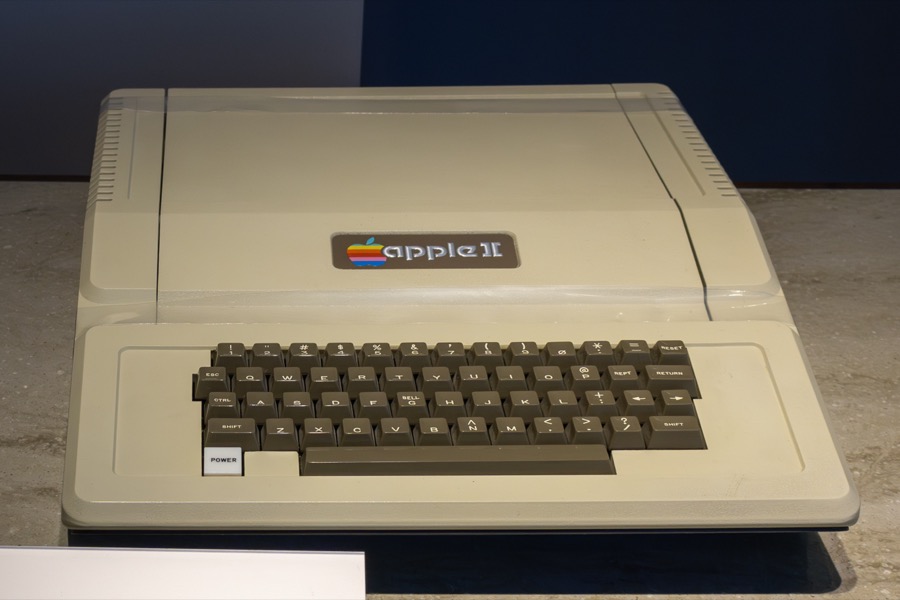
The Apple II at the Computer History Museum. Note the rainbow Apple logo, built-in keyboard, and the clean beige case — a radical departure from the bare circuit boards of the era. Photo: Wikimedia Commons, CC BY-SA 3.0
While the Apple I was a bare circuit board for hobbyists, the Apple II was designed from the start to be a consumer product. Wozniak’s engineering genius and Jobs’ obsession with design came together to create something the world had never seen.
2.1 The Specifications
| Spec | Apple II | Why It Mattered |
| Processor | MOS 6502 @ 1.023 MHz | Same affordable chip as Apple I |
| RAM | 4 KB (expandable to 48 KB) | Expandable — grow with your needs |
| Color Graphics | 6 colors, 280×192 pixels | FIRST personal computer with color display |
| Sound | Built-in speaker | Audio feedback for games and programs |
| Expansion Slots | 8 slots | Wozniak’s masterstroke — made Apple II infinitely extensible |
| Case | Molded plastic with built-in keyboard | Looked like a consumer product, not a science project |
| Software | Integer BASIC in ROM | Ready to program out of the box |
| Price | $1,298 (4KB) / $2,638 (48KB) | Expensive but complete — no assembly required |
2.2 The 8 Expansion Slots: Wozniak’s Greatest Design Decision
Jobs wanted a sleek, closed system. Wozniak insisted on 8 expansion slots — open connectors that allowed third-party hardware to plug directly into the Apple II’s motherboard.
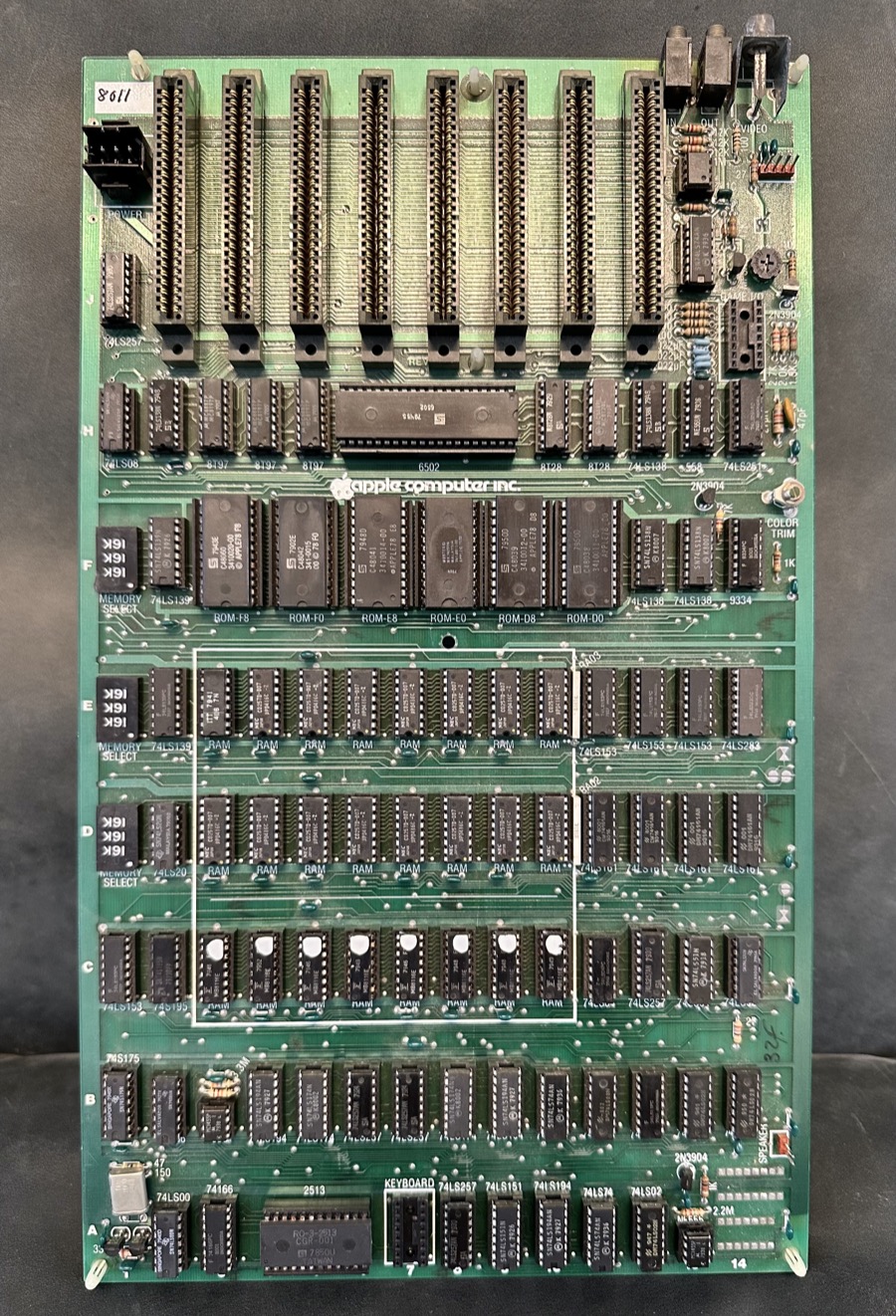
The Apple II motherboard with its 8 expansion slots visible along the back edge. These slots created an entire ecosystem of add-on cards. Photo: Wikimedia Commons, CC BY 2.0
This decision created an entire ecosystem. Third-party companies built memory expansion cards, printer interfaces, modem cards, sound cards, and — most importantly — the Disk II floppy drive controller. The expansion slots turned the Apple II from a closed product into an open platform.
The Irony: Jobs and Wozniak would fight about this exact issue for the rest of their careers. Jobs wanted closed, controlled systems (eventually winning with the Macintosh, iPod, iPhone). Wozniak wanted open, expandable platforms. The Apple II — Wozniak’s vision — remains the most successful open-architecture computer Apple ever made.
3. The West Coast Computer Faire: April 15–17, 1977
The Apple II made its public debut at the First West Coast Computer Faire at the San Francisco Civic Auditorium. Over 12,000 people attended — the largest personal computer event the world had ever seen.
Jobs understood showmanship. While most exhibitors had folding tables and hand-drawn signs, Apple had:
- 4 booths directly facing the building’s entrance — the first thing every visitor saw
- A backlit plexiglass display featuring the brand-new rainbow Apple logo (designed by Rob Janoff)
- 12 Apple II computers running color demos
- Professional signage and a polished, corporate appearance
What visitors didn’t know: the demo units were unfinished prototypes. The actual production Apple II wouldn’t ship until June 1977. Jobs was selling a vision, not a product — a pattern he would repeat for the rest of his career.
4. The Apple II with Monitor and Disk Drive
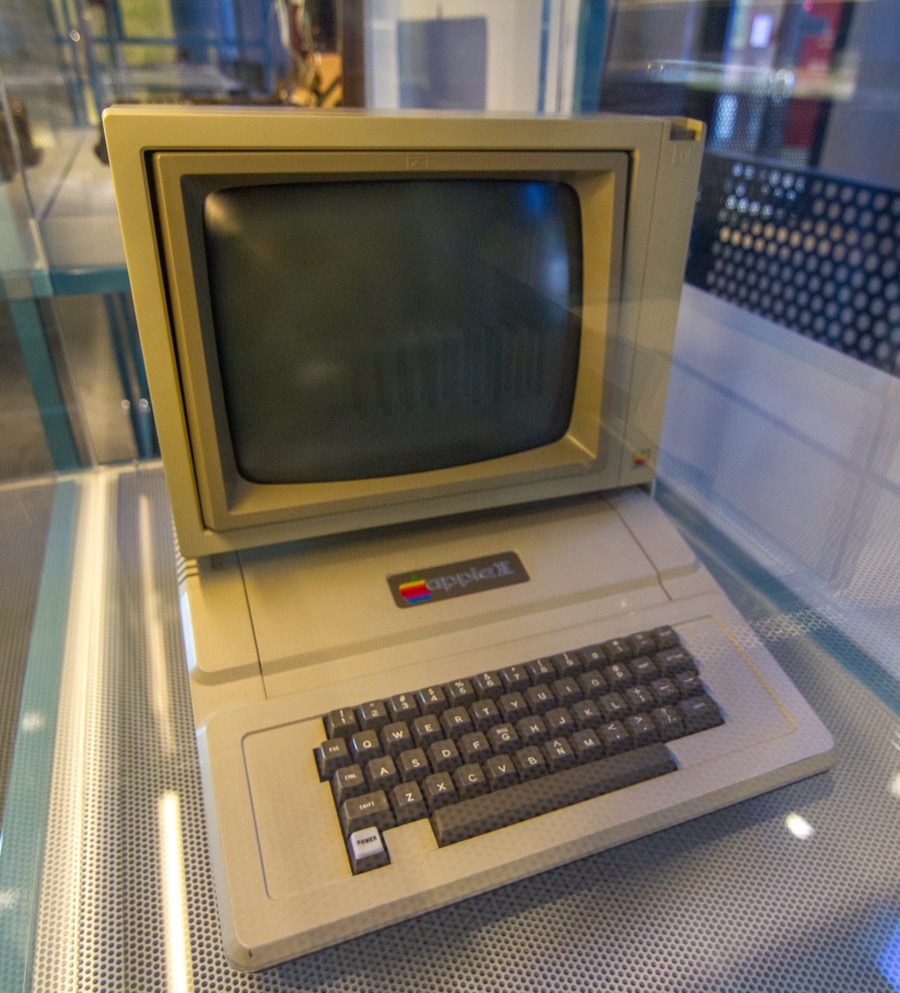
A complete Apple II system with monitor. This is what a real user’s desk looked like in 1977–1980. Photo: Wikimedia Commons, CC BY-SA 4.0
5. The Disk II: Wozniak’s Engineering Miracle (1978)
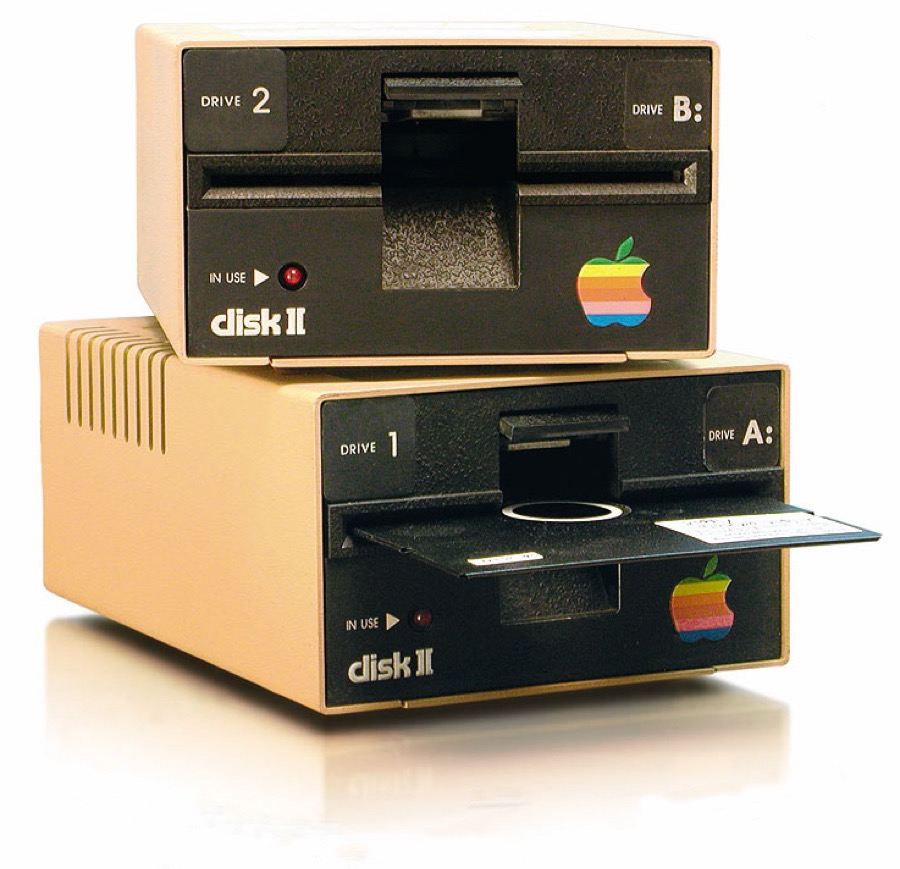
The Disk II floppy disk drive — designed by Wozniak in just two weeks over Christmas 1977. Note the rainbow Apple logo. Photo: Wikimedia Commons, CC BY-SA 3.0
In December 1977, Jobs challenged Wozniak to design a floppy disk controller for the Apple II. The industry-standard Shugart controller used about 50 chips. Over Christmas break, Wozniak designed a controller that used only 8 chips.
The Disk II shipped in July 1978 at $495 (drive + controller card). It was dramatically cheaper than competing floppy systems and turned the Apple II into a serious data-processing machine. Before the Disk II, programs loaded from cassette tape (slow, unreliable). After the Disk II, the Apple II could run real software.
Engineering Legend: Wozniak designed the Disk II controller in a two-week sprint, and the result was so elegant that engineers at other companies couldn’t believe it worked with so few chips. It was called "the most brilliant piece of engineering in the Apple II." Wozniak later said it was the project he was most proud of.
6. VisiCalc: The Killer App (1979)
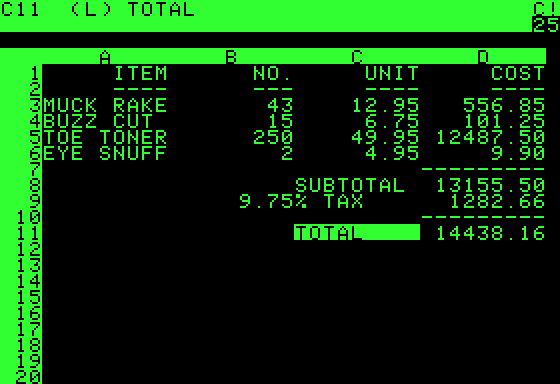
VisiCalc — the first electronic spreadsheet, running on the Apple II. This single program transformed the Apple II from a hobbyist toy into a business tool. Photo: Wikimedia Commons, Public Domain
In October 1979, Dan Bricklin and Bob Frankston released VisiCalc — the world’s first electronic spreadsheet. It ran exclusively on the Apple II.
The impact was immediate and transformative:
- Accountants and financial analysts who had never touched a computer bought Apple IIs specifically to run VisiCalc
- VisiCalc sold 700,000 copies in six years
- It’s estimated that VisiCalc sold more Apple IIs than any other factor — including Apple’s own marketing
- The concept of a "killer app" — a single software program so compelling that it drives hardware sales — was born
The Lesson: VisiCalc proved a truth that still holds in 2026: software sells hardware. The Apple II hardware was excellent, but it was VisiCalc that put it on every executive’s desk. This is the same dynamic we see today with AI models driving GPU sales, or the App Store driving iPhone adoption.
7. The "Introducing Apple II" Advertisement
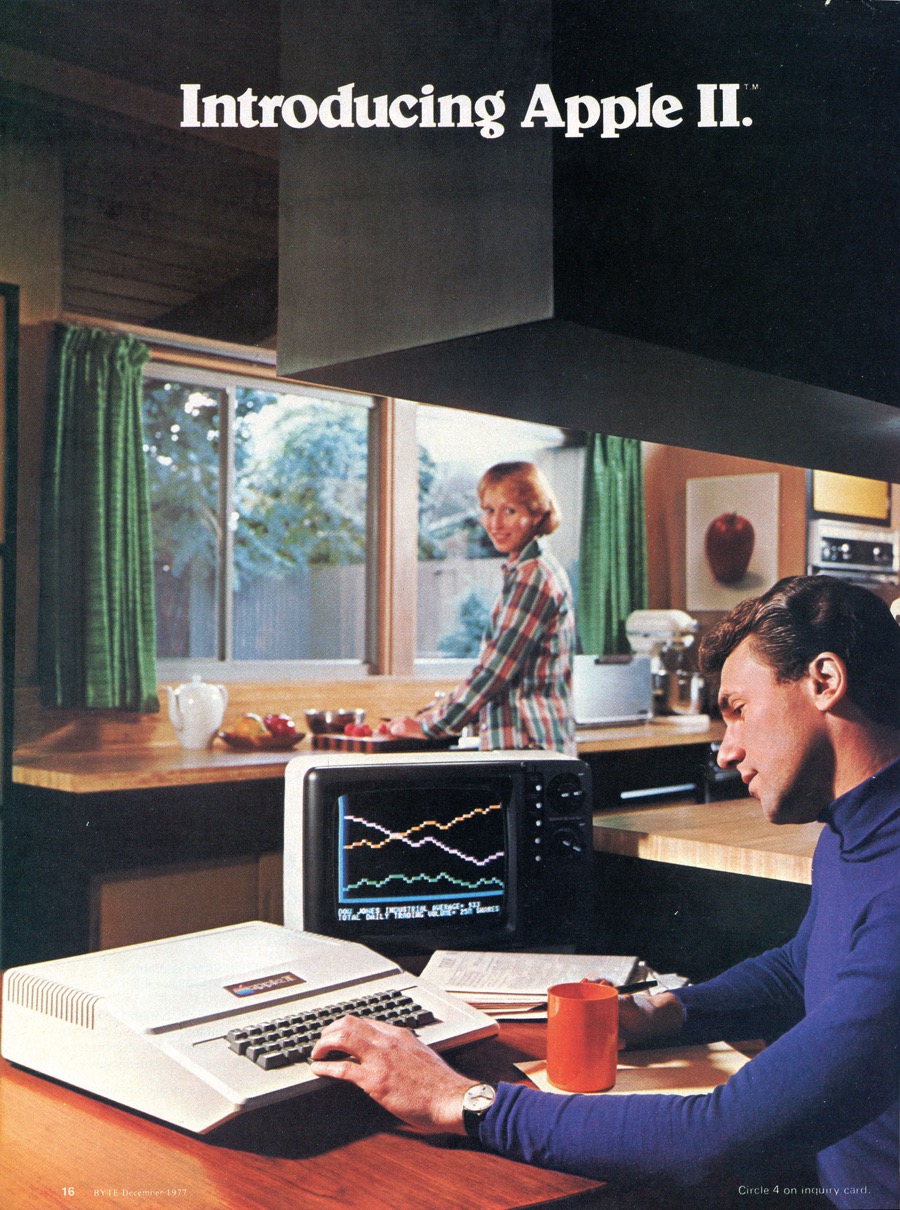
The famous "Introducing Apple II" ad from December 1977 — note how it shows the computer in a kitchen, not an office or lab. Apple was selling a lifestyle, not just a machine. Photo: Wikimedia Commons, Public Domain
This advertisement is a masterclass in positioning. While every other computer company showed their machines in laboratories or offices, Apple showed the Apple II in a home kitchen — with a wife approvingly looking on while her husband works. The message was clear: this computer belongs in your life, not in a lab.
8. The First Cracks: Jobs vs. Wozniak
As Apple grew from a two-person garage project to a company with hundreds of employees, the differences between Jobs and Wozniak became impossible to ignore:
| Issue | Jobs | Wozniak |
| Design Philosophy | Closed, controlled, beautiful | Open, expandable, hackable |
| Business Role | Wanted to be CEO, control everything | Wanted to be an engineer, build things |
| Credit | Positioned himself as Apple’s public face | Felt increasingly sidelined despite being the technical genius |
| The Apple III | Pushed the Apple III as a business machine (it flopped) | Wanted to keep improving the Apple II (which kept selling) |
The tension would only grow. But in 1977–1980, it was mostly invisible to the outside world, masked by Apple’s extraordinary success.
9. The IPO: December 12, 1980
On December 12, 1980, Apple Computer went public on the NASDAQ exchange. It was the largest IPO since Ford Motor Company in 1956.
| Metric | Value |
| IPO Price | $22 per share |
| End of Day 1 | $29 per share (+31.8%) |
| Company Valuation | $1.79 billion |
| Steve Jobs (age 25) | $256 million |
| Steve Wozniak | $116 million |
| Mike Markkula | $203 million |
| New millionaires created | Over 300 Apple employees |
In four years, Apple had gone from a $1,300 garage project to a $1.79 billion public company. Steve Jobs, at 25, became one of the youngest self-made multi-millionaires in American history.
The Ronald Wayne Factor: Remember Part 1? Ronald Wayne sold his 10% stake for $800 in April 1976. On IPO day, that stake would have been worth $179 million. Four and a half years. From $800 to $179 million. The most expensive business decision in history grew more expensive by the day.
10. By the Numbers: Apple’s Growth (1977–1980)
| Year | Revenue | Employees | Key Event |
| 1977 | $774,000 | ~10 | Apple II launches, first office in Cupertino |
| 1978 | $7.8 million | ~50 | Disk II ships, Apple II Plus announced |
| 1979 | $49 million | ~250 | VisiCalc launches, Apple III development begins |
| 1980 | $117 million | ~1,000 | IPO at $1.79 billion valuation |
Revenue growth: $774K → $117M in three years. That’s a 15,000% increase.
What Comes Next
The Apple II would continue selling well into the late 1980s, eventually moving over 5 million units. But by 1981, Jobs had his eyes on something new — a revolutionary computer inspired by a visit to Xerox PARC, where he saw a graphical user interface with windows, icons, and a mouse.
That vision would become the Macintosh. And the story of how it was built — and the power struggle it ignited — is one of the most dramatic chapters in business history.
Series Roadmap
| Part 1 | The Garage That Started It All (1976) |
| Part 2 (This Post) | The Apple II Boom (1977-1980) |
| Part 3 | The Macintosh Revolution (1984-1985) |
| Part 4 | The Dark Years (1985-1997) |
| Part 5 | The Greatest Comeback (1997-2001) |
| Part 6 | From iPod to iPhone (2001-2007) |
| Part 7 | The iPhone Era to Apple at 50 (2007-2026) |
All historical photos from Wikimedia Commons under Creative Commons licenses or Public Domain.
Sources: