
 العربية
 Español
 中文
中文 Deutsch
 Français
 Português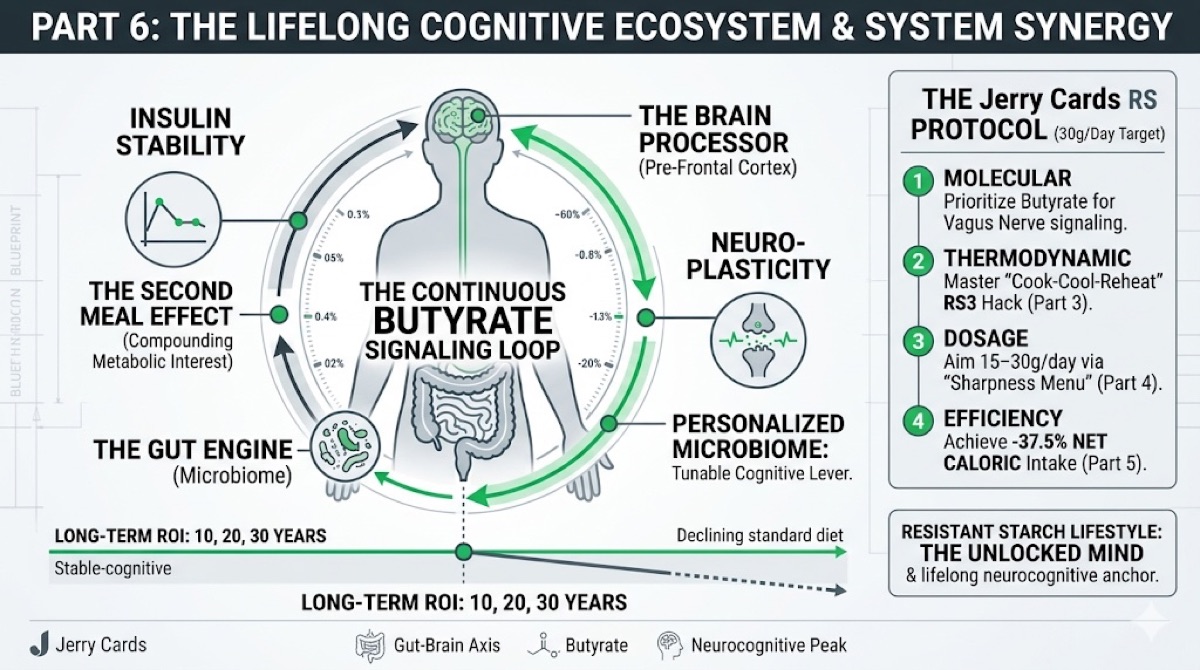
This is Part 6 (Final) of our Resistant Starch series. Part 1: animal evidence. Part 2-1: human clinical. Part 2-2: molecular mechanisms. Part 3: cook-cool-reheat. Part 4: 7-day protocol. Part 5: caloric cheat code. Now we bring the series full circle — from the microscopic world of the gut-brain axis to the long-term lifestyle of the Cognitive Athlete.
By April 2026, the clinical data is clear: resistant starch is not a supplement you take for a month. It is a fundamental shift in how we fuel our biological hardware — one that compounds over decades.
1. The Second Meal Effect as Compounding Interest
One of the most powerful findings in current nutrition research is the Second Meal Effect — and its implications for long-term health are profound.
The Mechanism: When you consume resistant starch at breakfast, the SCFAs produced by fermentation (primarily propionate and butyrate) improve your insulin sensitivity for the rest of the day — not just for that meal, but for lunch and dinner as well. Your cells become more responsive to glucose clearance for 8–12 hours after a single RS-rich meal.
The Compound Gain: Over years, this daily reduction in glycemic variability prevents the micro-inflammatory events in the brain that accumulate into age-related cognitive decline. Each morning’s RS intake is a "health premium" that compounds — like investing $1 per day that grows over 30 years.
1.1 The Mathematics of Compounding Protection
| Timeframe | Standard Diet (High GI) | RS Lifestyle (15–30g/day) |
| Daily | 2–4 glucose spikes, each triggering IL-6/TNF-α inflammatory bursts | Buffered glucose response, sustained butyrate production, stable energy |
| Year 1 | ~700–1,400 inflammatory micro-events in the brain | Dramatic reduction. Stable afternoon energy. Improved mood (RESISTA-PD, p=0.001) |
| Year 5 | Measurable hippocampal volume reduction (normal aging) | Diversified microbiome. Enhanced BDNF. Metabolic resilience. Visceral fat reduction. |
| Year 10–30 | Accelerating cognitive decline curve | Protected cognitive baseline. The gap between the two curves widens every year. |
This is why the infographic shows two diverging trajectories over 10, 20, and 30 years. The RS lifestyle doesn’t just slow decline — it maintains a higher cognitive baseline from which decline is measured.
2. The Personalized Microbiome: Your Tunable Cognitive Lever
As we move toward personalized nutrition, your RS intake becomes the most adjustable lever in your metabolic toolkit.
2.1 The Adaptation Phase (Month 1–3)
During the first weeks of consistent RS intake, your gut microbiome undergoes active remodeling:
- Butyrate-producing bacteria (Faecalibacterium, Roseburia, Eubacterium) expand in population
- Inflammatory and opportunistic bacteria decrease
- Short-chain fatty acid production ramps up progressively
- You may experience transient bloating as the ecosystem adjusts (start at 10g, increase 5g every 3–4 days)
2.2 The Resilience Phase (Month 3–6)
After 3–6 months of consistency, your microbiome reaches a new equilibrium:
- Bacterial diversity stabilizes at a higher baseline
- The ecosystem becomes resilient — it can handle occasional high-GI meals without the catastrophic "brain fog" of the past
- The Second Meal Effect becomes more pronounced as butyrate-producing populations mature
2.3 The Optimization Phase (Month 6+)
This is where RS becomes a tunable lever:
| Need more deep-work capacity? | Up-regulate RS3 intake (more cold starches at lunch) to provide slow-burn prefrontal cortex fuel for afternoon sessions |
| High-stress period? | Increase RS + fermented foods to maximize butyrate and serotonin precursor availability |
| Maintenance mode? | Relax strict meal prep. Your diversified microbiome handles variability. Keep overnight oats and cold rice as daily defaults. |
| Travel or disruption? | Carry green banana flour (RS2 supplement). 1 tbsp in water = instant 8g RS regardless of available food. |
3. The Complete Jerry Cards RS Protocol
| 1 | MOLECULAR | Prioritize butyrate for vagus nerve signaling. Feed Faecalibacterium and Roseburia with their preferred substrate: resistant starch. (Part 2-2) |
| 2 | THERMODYNAMIC | Master the Cook-Cool-Reheat method. 24h at 4°C triggers retrogradation, boosting RS3 by up to 300%. RS3 survives reheating. (Part 3) |
| 3 | DOSAGE | Aim for 15–30g RS/day using the 7-Day Sharpness Menu: overnight oats (RS2), cold rice/potato salad (RS3), green banana (RS2), cooled lentils (RS3). (Part 4) |
| 4 | EFFICIENCY | Enjoy the -37.5% net caloric reduction + selective visceral fat targeting + GLP-1/PYY satiety (the same pathway as Ozempic). (Part 5) |
4. Frequently Asked Questions
Q: Can I just take RS as a supplement instead of changing my diet?
You can supplement with raw potato starch or green banana flour (RS2) — 1–2 tablespoons per day in cold smoothies provides 8–16g RS. But food-based RS3 (cook-cool-reheat) provides additional benefits: the retrogradation process also increases dietary fiber, improves texture and satiety, and creates RS5 when combined with fats. Supplements are a shortcut; food-based RS is the complete package.
Q: Is this safe for diabetics?
Meta-analyses show RS improves glycemic control in type 2 diabetes — reducing fasting glucose, fasting insulin, and insulin resistance (HOMA-IR). However, diabetics should start at low doses (5–10g/day) and monitor blood glucose responses. Consult your physician before making significant dietary changes.
Q: How long until I notice effects?
| Days 3–5 | Stable afternoon energy (no post-lunch crash) |
| Week 2–3 | Improved morning clarity, more regular digestion |
| Month 1–2 | Measurable mood improvement, reduced anxiety |
| Month 3–6 | Microbiome diversification, metabolic resilience, visceral fat reduction |
Q: What if I experience bloating?
Bloating means your microbiome is adapting — it’s a sign the fermentation is working, but you’ve increased too fast. Drop back to 10g/day and increase by 2–3g every 48 hours. Pair with adequate water and vegetables. The bloating resolves within 1–2 weeks as butyrate-producing bacteria populations stabilize.
5. The Unlocked Mind
At Jerry Cards, our mission is about unlocking access. Whether it’s US digital content for international customers or the hidden potential of your own neurochemistry, the goal is the same: removing the barriers between you and your peak performance.
Over six parts, we’ve shown that resistant starch:
- Reshapes your gut microbiome to produce butyrate (Part 1)
- Improves depression scores in human clinical trials at p = 0.001 (Part 2-1)
- Repairs the blood-brain barrier and protects the tryptophan-serotonin pathway (Part 2-2)
- Can be tripled in any meal by cooling cooked starch for 24 hours (Part 3)
- Fits into a practical 7-day menu targeting 30g/day (Part 4)
- Reduces effective calories by 37.5% and selectively targets visceral fat (Part 5)
Resistant starch is the simplest, most scientifically validated "unlock" available today. Start with one cold potato or a spoonful of green banana flour, and watch your cognitive horizon expand.
THE RESISTANT STARCH LIFESTYLE: THE UNLOCKED MIND
Complete Series Index
| Part 1 | Animal model evidence — RS reshapes gut microbiome for cognition |
| Part 2-1 | Human clinical — RESISTA-PD trial, BDI improvement (p=0.001) |
| Part 2-2 | Molecular mechanisms — butyrate, NF-κB, BBB, tryptophan protection |
| Part 3 | Cook-Cool-Reheat hack — retrogradation, RS types, +300% RS3 |
| Part 4 | 7-Day Brain Sharpness Protocol — 30g RS/day menu |
| Part 5 | The Caloric Cheat Code — -37.5% calories, visceral fat, GLP-1 |
| Part 6 (This Post) | The Lifelong Cognitive Ecosystem — compounding ROI, personalized microbiome |
Sources (Series-Wide):
- Kadyan et al. (2024), Frontiers in Nutrition — RS and Neurocognitive Health
- Becker et al. — RESISTA-PD Trial
- Yang et al. (2023) — Prebiotics for Depression
- PMC: Harnessing the Power of Resistant Starch (2024)
- PMC: Resistant Starch and Energy Balance
- PMC: RS Upregulates GLP-1 and PYY
- PubMed: RS Reduces Abdominal Fat