
 العربية
 Español
 中文
中文 Deutsch
 Français
 Português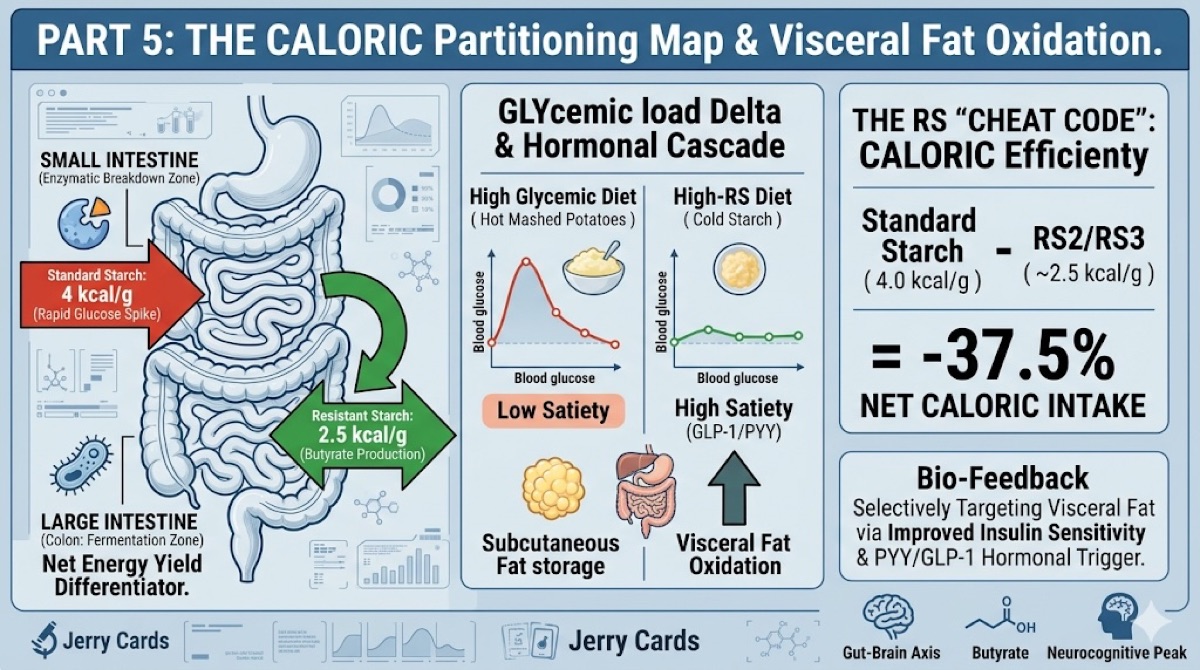
This is Part 5 of our Resistant Starch series. Part 1: animal evidence. Part 2-1: human clinical. Part 2-2: molecular mechanisms. Part 3: cook-cool-reheat. Part 4: 7-day protocol. Now we examine the metabolic "cheat code" that makes RS unique among all dietary interventions.
While our focus has been the brain, the way the body processes resistant starch calories is a masterclass in thermodynamic efficiency. In 2026, we no longer look at a calorie as just a calorie. We look at the Metabolic Cost of Digestion.
1. The 2.5 vs. 4.0 kcal/g Disparity
Standard digestible starch is absorbed in the small intestine via enzymatic breakdown (amylase → maltose → glucose). This process is rapid and efficient, yielding approximately 4 calories per gram.
Resistant starch follows a completely different metabolic pathway:
| Parameter | Standard Starch | Resistant Starch |
| Absorption Site | Small intestine (enzymatic) | Large intestine (bacterial fermentation) |
| Energy Yield | ~4.0 kcal/g | ~2.5–2.8 kcal/g |
| Primary Products | Glucose (blood sugar) | SCFAs (butyrate, propionate, acetate) |
| Glycemic Impact | High (GI 70–80) | Low/None |
| Net Caloric Reduction | — | −37.5% |
The Physics: When bacteria ferment RS, the energy extraction process is inherently less efficient than enzymatic digestion. The bacteria consume a portion of the energy for their own metabolism. The fermentation byproducts (SCFAs) are absorbed by colonocytes and enter the bloodstream as fatty acids — a slower, lower-yield energy source than glucose. Lab measurements show metabolizable energy values of 2.8 kcal/g for high-amylose resistant starch (Hi-Maize 260) compared to 3.5 kcal/g for standard Amioca cornstarch (PMC Review).
The practical math: If you eat 200g of rice per day and 30% of that starch is now RS3 (from the cook-cool-reheat method), you’ve effectively reduced the caloric contribution of that rice by ~50–70 calories per day — without changing the volume, taste, or satiety. Over a year, that’s the equivalent of ~2.5 kg of fat loss from a single dietary modification.
2. The Hormonal Cascade: GLP-1 and PYY
The caloric reduction is only half the story. When gut bacteria ferment RS into butyrate and other SCFAs, it triggers a powerful hormonal response.
2.1 GLP-1 (Glucagon-Like Peptide-1)
- GLP-1 is your body’s primary "stop eating" signal
- It slows gastric emptying (food stays in your stomach longer, extending satiety)
- It enhances insulin secretion in a glucose-dependent manner
- RS upregulates GLP-1 in a sustained, day-long manner — not just at mealtime (PMC Study)
2.2 PYY (Peptide YY)
- PYY signals satiety to the hypothalamus (the brain’s appetite center)
- It reduces gut motility, extending the feeling of fullness
- Like GLP-1, it is upregulated by RS fermentation throughout the day, independent of meal timing
The GLP-1 Connection to Modern Medicine: GLP-1 receptor agonists (semaglutide/Ozempic, tirzepatide/Mounjaro) are the most successful weight-loss drugs in history, generating over $20 billion in annual revenue. They work by mimicking the GLP-1 signal. Resistant starch stimulates your body’s own GLP-1 production through a natural fermentation pathway. It’s not a replacement for pharmaceutical GLP-1 agonists, but it’s a free, food-based way to boost the same hormonal pathway.
3. Selective Visceral Fat Targeting
This is the most clinically significant finding for long-term health. RS doesn’t just reduce overall body fat — it selectively targets visceral fat.
3.1 Why Visceral Fat Matters
Visceral fat (the fat surrounding internal organs) is the most metabolically dangerous type of body fat:
- Secretes pro-inflammatory cytokines (IL-6, TNF-α) that drive chronic disease
- Impairs insulin signaling at the organ level
- Is the primary risk factor for type 2 diabetes, cardiovascular disease, and certain cancers
- Cannot be effectively targeted by exercise alone — it responds primarily to metabolic and hormonal signals
3.2 How RS Targets Visceral Fat
| Mechanism | Effect on Visceral Fat |
| Butyrate → Improved insulin sensitivity | Cells become more responsive to insulin, redirecting fat metabolism away from visceral storage and toward oxidation |
| GLP-1/PYY → Reduced caloric intake | Natural appetite suppression reduces overall energy surplus |
| Propionate → Hepatic fat oxidation | Propionate (another SCFA) is absorbed by the liver and increases hepatic fat oxidation |
| ↓ Inflammation → ↓ Fat storage signals | By reducing NF-κB inflammation (Part 2-2), RS removes the chronic signal that promotes visceral fat accumulation |
Clinical evidence from multiple trials demonstrates that RS from high-amylose maize significantly reduces abdominal fat, with both visceral and subcutaneous fat areas decreased alongside improved insulin, C-peptide, and GLP-1 secretion.
4. The Thermogenic Edge: Dietary Induced Thermogenesis
Digesting fiber and resistant starch is hard work for your microbiome. The fermentation process itself consumes energy — bacteria need ATP to break down the crystalline RS3 structure.
This Dietary Induced Thermogenesis (DIT) means your body expends more energy processing RS than it does with simple sugars:
| Simple sugars | ~5–10% of caloric content spent on digestion |
| Protein | ~20–30% DIT (why high-protein diets feel efficient) |
| Resistant starch | Reduced energy yield (~2.5 kcal/g) + fermentation cost = lowest net metabolizable energy of any carbohydrate |
You are essentially paying your gut bacteria to burn calories. They do the work; you get the benefits.
5. The "Metabolic Arbitrage" Summary
Same food volume. Same satiety. Same (or better) taste.
37.5% fewer effective calories.
Selective visceral fat reduction.
Enhanced GLP-1/PYY satiety signals (the same pathway as Ozempic).
Butyrate-driven brain benefits (Parts 1–2).
That’s not a diet. That’s metabolic arbitrage — getting more output (satiety, brain function, fat loss) from less input (calories, glycemic load).
6. Series Roadmap
| Part 1 | Animal model evidence |
| Part 2-1 | Human clinical — RESISTA-PD trial (p=0.001) |
| Part 2-2 | Molecular mechanisms — butyrate, NF-κB, BBB, tryptophan |
| Part 3 | Cook-Cool-Reheat hack — retrogradation, RS types |
| Part 4 | 7-Day Brain Sharpness Protocol |
| Part 5 (This Post) | The Caloric Cheat Code — visceral fat, GLP-1, metabolic arbitrage |
| Part 6 (Final) | Summary & The Future — RS as a lifelong cognitive tool |
Sources:
- PMC: Resistant Starch and Energy Balance: Impact on Weight Loss and Maintenance
- PMC: RS Upregulates GLP-1 and PYY in a Day-Long Manner
- PubMed: RS from High-Amylose Maize Reduces Abdominal Fat
- PMC: RS Lowers Postprandial Glucose and Leptin
- Scientific Reports: Metabolic Phenotypes in Response to RS Type 2