
 العربية
 Español
 中文
中文 Deutsch
 Français
 Português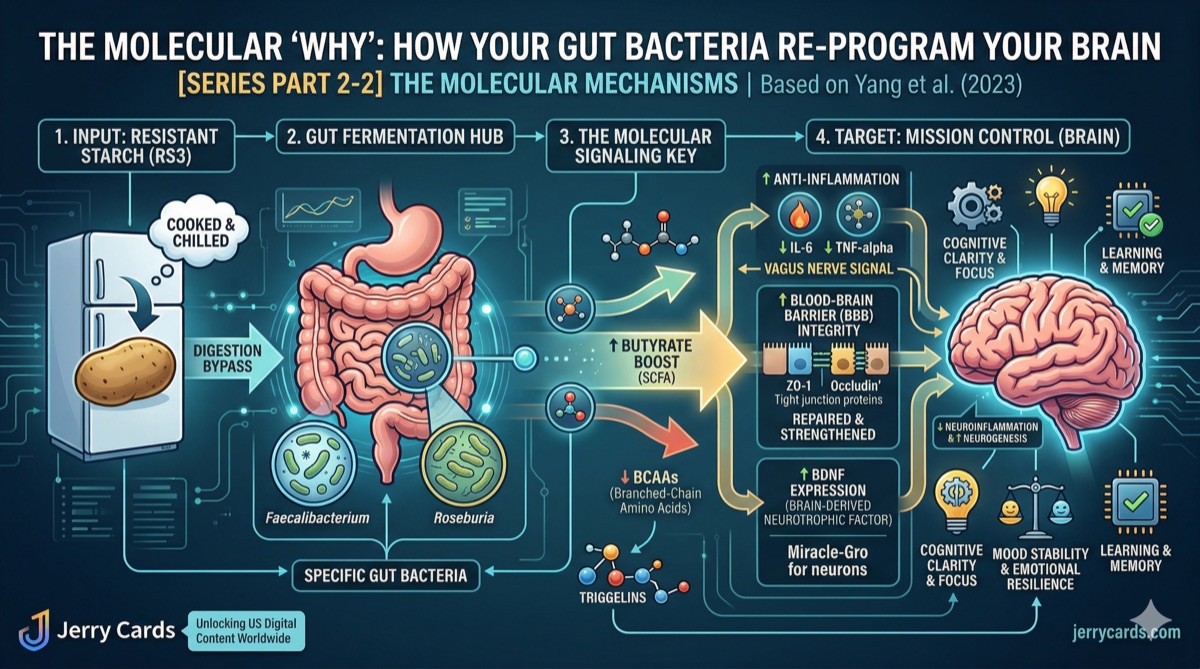
This is Part 2-2 of our Resistant Starch series. Part 1 covered the animal model evidence. Part 2-1 proved it works in humans (RESISTA-PD trial, BDI improvement p = 0.001). Now we go deep into the molecular "why."
How does a starch in your colon change the way you feel in your head? A comprehensive 2023 review in Frontiers in Nutrition (Yang et al., DOI: 10.3389/fnut.2023.1206468) from Tongji Medical College has mapped the complete Gut-Microbiome-Brain Axis signaling pathways. It turns out, resistant starch isn’t just food — it’s a software update for your neurochemistry.
The Three Pillars of Brain Stabilization
Pillar 1: The Butyrate "Master Key"
When specific bacteria (Faecalibacterium prausnitzii, Roseburia, Eubacterium rectale) ferment resistant starch in the colon, they produce butyrate — a short-chain fatty acid (SCFA) that functions as both cellular fuel and a potent signaling molecule.
Butyrate operates through at least four distinct molecular mechanisms:
| Mechanism | Molecular Target | Downstream Effect |
| HDAC Inhibition | Histone deacetylase enzymes | Epigenetic suppression of pro-inflammatory genes. Same mechanism used by certain cancer drugs (e.g., vorinostat). |
| NF-κB Suppression | Nuclear factor kappa-light-chain-enhancer of activated B cells | Reduces production of IL-6, TNF-α, IL-1β — the trio of cytokines most implicated in neuroinflammation and depression. |
| BDNF Upregulation | Brain-Derived Neurotrophic Factor gene | Promotes neurogenesis, synaptic plasticity, and long-term potentiation (the cellular basis of learning and memory). |
| GPR41/GPR43 Activation | G-protein coupled receptors on enteroendocrine cells | Triggers release of GLP-1 and PYY — peptides that signal satiety to the brain and modulate dopamine reward circuits. |
Key statistic: Patients with Major Depressive Disorder (MDD) have 40–60% less butyrate in their gut than healthy controls (Frontiers in Pharmacology, 2024). This depletion is directly associated with the severity of depressive symptoms. Resistant starch is the single most efficient dietary substrate for replenishing butyrate.
Pillar 2: Fortifying the Blood-Brain Barrier (BBB)
The Blood-Brain Barrier is a selective membrane of endothelial cells that prevents most circulating molecules from entering the brain. It is your brain’s firewall.
When the BBB is compromised ("leaky"), systemic inflammatory molecules flood the brain, triggering neuroinflammation — a process now recognized as a primary driver of depression, anxiety, and cognitive decline.
How butyrate repairs the BBB:
- Upregulates tight junction proteins: ZO-1 (Zonula Occludens-1), Occludin, and Claudin-5 — the molecular "rivets" that hold BBB cells together
- Reduces endothelial cell apoptosis (cell death) in BBB tissue
- Suppresses matrix metalloproteinases (MMPs) that degrade the BBB during inflammation
Think of it this way: if your brain is a server room, the BBB is the door with a keycard lock. Neuroinflammation breaks the lock. Butyrate installs a new, stronger one.
Pillar 3: The BCAA Reduction
Branched-Chain Amino Acids (BCAAs) — leucine, isoleucine, and valine — are essential nutrients in moderation. But elevated blood BCAAs are a metabolic red flag, associated with:
- Insulin resistance (they compete with tryptophan for transport across the BBB)
- mTOR overactivation (linked to cellular stress and neuroinflammation)
- Reduced serotonin availability (BCAAs and tryptophan share the same LAT1 transporter; high BCAAs means less tryptophan reaches the brain)
The Yang review highlights a consistent finding across multiple studies: resistant starch fermentation lowers circulating BCAAs. This has a dual benefit: it reduces metabolic stress and it clears the way for tryptophan to enter the brain and be converted to serotonin.
The Fourth Pathway: Tryptophan Protection (The Serotonin Shield)
This pathway deserves special attention because it directly explains why gut inflammation causes depression:
The Normal State: Tryptophan (essential amino acid from food) → TPH1/TPH2 enzymes → Serotonin (5-HT) → mood stability, sleep regulation, social bonding
The Inflammatory Hijack: When IL-6 and TNF-α are elevated, they activate the enzyme indoleamine 2,3-dioxygenase (IDO). IDO diverts tryptophan into the kynurenine pathway, producing:
- Quinolinic acid — an NMDA receptor agonist that is directly neurotoxic
- 3-hydroxykynurenine — generates reactive oxygen species (ROS) in neurons
- Result: Less serotonin produced + active neurotoxin generation = depression + cognitive impairment
What butyrate does: By suppressing IL-6 and TNF-α through NF-κB inhibition, butyrate prevents IDO activation. Tryptophan stays in the serotonin pathway instead of being diverted to kynurenine. Additionally, certain butyrate-producing bacteria directly enhance TPH1 expression in gut enterochromaffin cells, boosting serotonin synthesis at the source.
This is why the "chemical imbalance" theory of depression is being replaced by the neuroinflammation model. The serotonin deficit isn’t random — it’s caused by inflammation systematically diverting your raw materials into toxic byproducts.
The Vagus Nerve: The Physical Highway
All of this signaling doesn’t happen magically. There is a physical nerve connecting gut to brain: the vagus nerve (cranial nerve X).
- ~80% of vagal fibers are afferent (carrying signals from gut to brain, not the other way around)
- Butyrate activates vagal afferent terminals in the gut wall
- Signals travel to the nucleus tractus solitarius (NTS) in the brainstem
- From NTS, they propagate to the hypothalamus (↓ HPA axis → ↓ cortisol), amygdala (↓ anxiety), and prefrontal cortex (↑ executive function)
The vagus nerve is essentially a fiber optic cable running from your gut bacteria to your emotional processing centers. Butyrate is the signal it carries.
The Complete Signaling Network
INPUT: Resistant Starch (10g/day RS3)
↓
FERMENTATION: Faecalibacterium, Roseburia, Eubacterium → Butyrate + Propionate + Acetate
↓
┌───────────────────┬───────────────────┬───────────────────┬─────────────────┐
│ Path A │ Path B │ Path C │ Path D │
│ HDAC inhibition │ Vagus nerve │ ↓IDO activation │ ↑BBB tight │
│ ↓NF-κB │ → NTS → brain │ ↑Trp→Serotonin │ junctions │
│ ↓IL-6, TNF-α │ ↓HPA/cortisol │ (not kynurenine) │ ↓neuroinflam │
└───────────────────┴───────────────────┴───────────────────┴─────────────────┘
↓
+ ↑BDNF + ↓BCAAs
↓
OUTPUT: Improved Mood, Reduced Anxiety, Enhanced Cognition, Emotional Resilience
The Analogy: Brain Hardware vs. Gut Firmware
We often think of "brain health" as something we fix with puzzles, meditation apps, or nootropic supplements. But the molecular data tells a different story.
The hardware of your brain — the neurons, the synapses, the blood-brain barrier, the neurotransmitter synthesis pathways — is largely maintained by the firmware in your gut. The bacteria. The fermentation products. The butyrate.
If you aren’t feeding the bacteria that produce butyrate, you are running your "Brain CPU" without a cooling system. It will work for a while. But eventually, the inflammation builds up, the barrier degrades, the serotonin gets diverted, and the system starts to crash.
That crash has a clinical name: depression.
What This Review Adds Beyond Part 2-1
The RESISTA-PD trial (Part 2-1) showed that RS works in humans. The Yang et al. review shows why it works at the molecular level:
| Part 2-1 (Clinical) | 10g RS3/day → BDI scores improved (p=0.001), butyrate ↑, calprotectin ↓ |
| Part 2-2 (Mechanism) | Butyrate → HDAC inhibition + NF-κB suppression + BBB repair + IDO blockade + BDNF ↑ + BCAA ↓ + vagal signaling |
Together, they form a complete evidence chain from dietary input to molecular mechanism to clinical outcome.
What’s Next
- Part 2-3: The Kitchen Lab — RS2 vs RS3 vs RS4: the molecular physics of "cook then chill." Why the temperature of your fridge literally determines starch crystal structure. (The most practical post in the series.)
- Part 3: The Brain Sharpness Menu — A 7-day meal plan optimized for butyrate production.
Sources:
- Yang et al. (2023), Prebiotics for depression: how does the gut microbiota play a role? — Frontiers in Nutrition (Open Access)
- PMC Full Text
- Butyrate and the Beast: Butyrate in Parkinson’s Disease (2024)
- Psychobiotics in Focus for Depression Therapy (2025)
- Part 2-1: RESISTA-PD Clinical Evidence (Jerry Cards)
- Part 1: Animal Model Evidence (Jerry Cards)