
 العربية
 Español
 中文
中文 Deutsch
 Français
 Português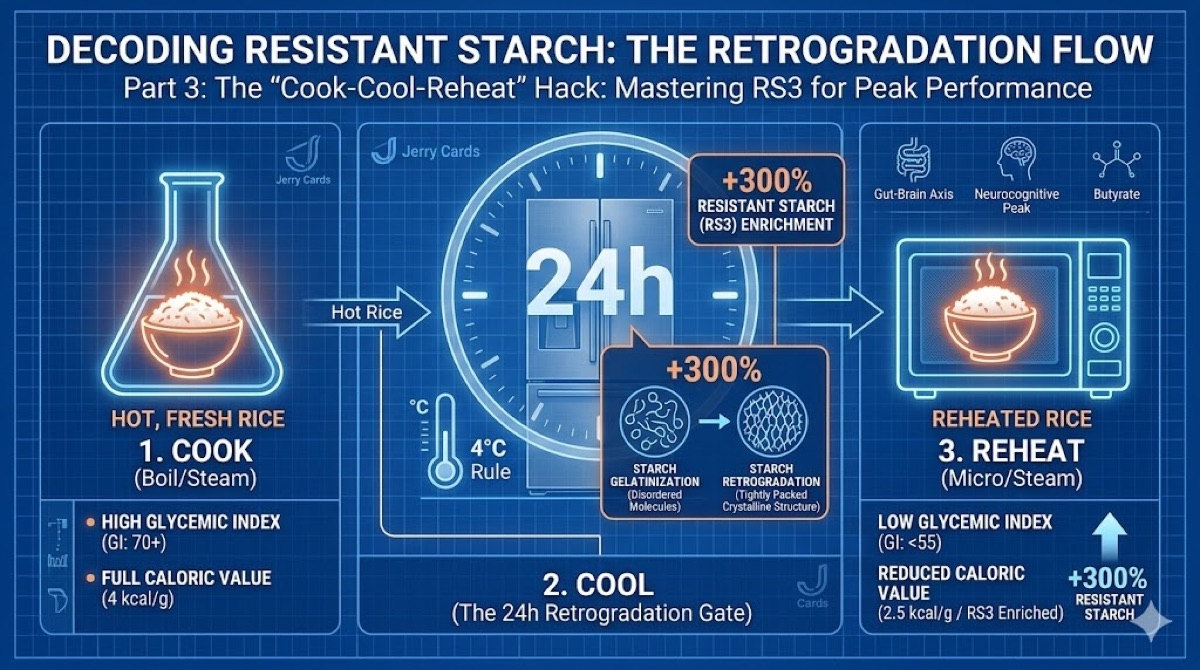
This is Part 3 of our Resistant Starch series. Part 1 covered the animal model evidence. Part 2-1 proved it works in humans (BDI improvement, p=0.001). Part 2-2 mapped the molecular mechanisms. Now we answer the most practical question: how do we maximize resistant starch in daily meals without eating raw potato flour?
The answer lies in a thermodynamic process called retrogradation — and it requires nothing more than a refrigerator and 24 hours of patience.
1. The Three Types of Resistant Starch
Not all resistant starch is created equal. Understanding the types is essential for choosing the right strategy:
| Type | Name | Sources | Practicality |
| RS1 | Physically inaccessible | Whole grains, seeds, legumes (intact cell walls trap starch) | Moderate — requires whole, minimally processed foods |
| RS2 | Raw/granular | Green (unripe) bananas, raw potato starch, high-amylose corn starch | High RS content but poor palatability. Best as a supplement (~8g RS per tablespoon of potato starch) |
| RS3 | Retrograded | Cooked & cooled potatoes, rice, pasta, oats | The Gold Standard. Easy to integrate into real meals via cook-cool-reheat. |
| RS4 | Chemically modified | Industrial food additives, modified corn starch | Stable but artificial. Avoid for a clean, natural approach. |
| RS5 | Starch-lipid complex | Forms when starch is cooked with fat (coconut oil + rice) | Bonus type — an advanced hack (see Section 5) |
2. The "Cook-Cool-Reheat" Protocol: The Science of Retrogradation
2.1 What Happens at the Molecular Level
When you cook starch (rice, potatoes, pasta), the crystalline structure of amylose and amylopectin molecules breaks down — a process called gelatinization. The starch becomes soft, digestible, and high-glycemic.
When you cool it for 12–24 hours at 4°C, something remarkable happens: the amylose molecules slowly realign into a new, tightly packed crystalline structure. This new structure is resistant to human digestive enzymes — it passes through the small intestine intact and reaches the colon, where it feeds butyrate-producing bacteria.
This process is called retrogradation, and the resulting starch is RS3.
The Physics: Retrogradation is a nucleation-and-crystal-growth process. During cooling, amylose chains (linear polymers) form double helices that aggregate into crystalline domains. The process is temperature-dependent: it proceeds fastest at 4°C (refrigerator temperature) and requires a minimum of 12 hours for significant crystal formation. The crystalline RS3 has a melting point of ~150°C — well above normal reheating temperatures — which is why RS3 survives reheating.
2.2 The 3-Step Protocol
| Step | Action | Details |
| 1. COOK | Boil or steam normally | Cook rice, potatoes, pasta, or oats as you normally would. No special preparation needed. |
| 2. COOL | Refrigerate at 4°C for 12–24h | This is the retrogradation gate. The amylose molecules need time and cold to recrystallize. 24 hours is optimal. Do NOT freeze — freezing disrupts the crystal formation process differently. |
| 3. REHEAT | Microwave or steam briefly | The key insight: RS3 survives reheating. Retrograded amylose crystals melt at ~150°C; your microwave reaches ~100°C. You get warm food with cold-food benefits. Only ~25% of RS3 is lost on reheating. |
2.3 The Clinical Evidence
| Metric | Freshly Cooked | Cooled 24h + Reheated | Change |
| RS content (white rice) | 0.64 g/100g | 1.65 g/100g | +158% |
| RS content (potatoes) | 3–5% | 10–15% | up to +300% |
| Glycemic Index (white rice) | ~78 (High) | ~54 (Medium-Low) | −24 points |
| Effective calories | 4 kcal/g | 2.5 kcal/g | −37.5% |
Sources: Sonia et al., Asia Pacific Journal of Clinical Nutrition (2015), PMC Review: Harnessing the Power of Resistant Starch (2024)
3. The "Second Meal Effect"
One of the most powerful findings in RS research is the second meal effect: eating resistant starch at one meal improves your glycemic response at the next meal, even if that next meal contains no RS.
The Mechanism: RS fermentation produces short-chain fatty acids (primarily butyrate and propionate) that reduce free fatty acid rebound between meals. Free fatty acids compete with glucose for cellular uptake — when FFAs are lower, your cells absorb glucose more efficiently, improving insulin sensitivity.
The Practical Impact: Eat cooled rice at lunch → better insulin response at dinner. This means you get metabolic benefits that extend beyond the RS-containing meal itself.
4. Advanced Hacks: Acid and Fat Synergies
4.1 The Acid Hack (Vinegar / Lemon Juice)
Adding acid to starchy foods inhibits amylase (the enzyme that breaks down starch), further slowing digestion and lowering glycemic response. This is why sushi rice (dressed with rice vinegar) has a lower GI than plain cooked rice — the acid stabilizes the RS3 structure.
Practical application: Dress your cooled rice with a tablespoon of apple cider vinegar or lemon juice before reheating.
4.2 The Fat Hack (Coconut Oil / Olive Oil)
A 2024 review confirmed that cooking rice with a small amount of fat (especially coconut oil) and then cooling it creates RS5 — a starch-lipid complex where fat molecules intercalate between amylose helices, creating an additional layer of digestive resistance.
Recipe: Add 1 teaspoon of coconut oil per cup of rice during cooking. Cool for 24 hours. Reheat. You now have RS3 + RS5 — double protection.
5. Daily Targets and Practical Dosing
| Current average intake | ~4g RS/day (most Western diets) |
| Target for neurocognitive benefits | 15–30g RS/day (based on clinical evidence from Parts 1-2) |
| Starting dose | 10g/day, increasing by 5g every 3–4 days |
| Warning | Jumping from 4g to 30g overnight will cause significant bloating and gas. Your gut bacteria need time to adapt. |
5.1 Quick RS Content Reference
| Food | Preparation | RS Content |
| Potato (medium) | Cooked + cooled 24h | ~8–12g RS3 |
| White rice (1 cup cooked) | Cooked + cooled 24h | ~3–5g RS3 |
| Lentils (1 cup cooked) | Cooked + cooled | ~4–6g RS (mix of RS1+RS3) |
| Green banana (1 medium) | Raw/unripe | ~5–8g RS2 |
| Overnight oats (100g) | Soaked overnight in fridge | ~4–6g RS3 |
| Raw potato starch | 1 tablespoon in smoothie | ~8g RS2 |
6. The Repeat Cycle Bonus
Research shows that repeating the cool-reheat cycle (cook → cool → reheat → cool again → reheat again) can further increase RS3 content with each cycle. Each cooling period allows additional amylose recrystallization. This is why meal-prepping a large batch of rice on Sunday and reheating portions throughout the week is both convenient and metabolically optimal.
7. Series Roadmap
| Part 1 | Animal model evidence — RS reshapes gut microbiome for cognition |
| Part 2-1 | Human clinical — RESISTA-PD trial, BDI improvement (p=0.001) |
| Part 2-2 | Molecular mechanisms — butyrate, NF-κB, BBB, tryptophan protection |
| Part 3 (This Post) | The Cook-Cool-Reheat Hack — RS2 vs RS3 vs RS4, retrogradation |
| Part 4 (Next) | The 7-Day "Brain Sharpness" Menu — hitting 30g RS/day |
| Part 5 | The Weight-Loss Side Effect — RS as a caloric cheat code |
Sources:
- PMC: Harnessing the Power of Resistant Starch (2024 Review)
- Sonia et al.: Effect of Cooling on RS Content and Glycemic Response
- PMC: Physical Processing Techniques to Enhance RS (2024)
- Frontiers: Cooking and Storage Temperature Effects on RS
- Clemson University: Starch Retrogradation for Blood Sugar Management
- European Journal of Clinical Nutrition: Second-Meal Glycemic Response