
 العربية
 Español
 中文
中文 Deutsch
 Français
 Português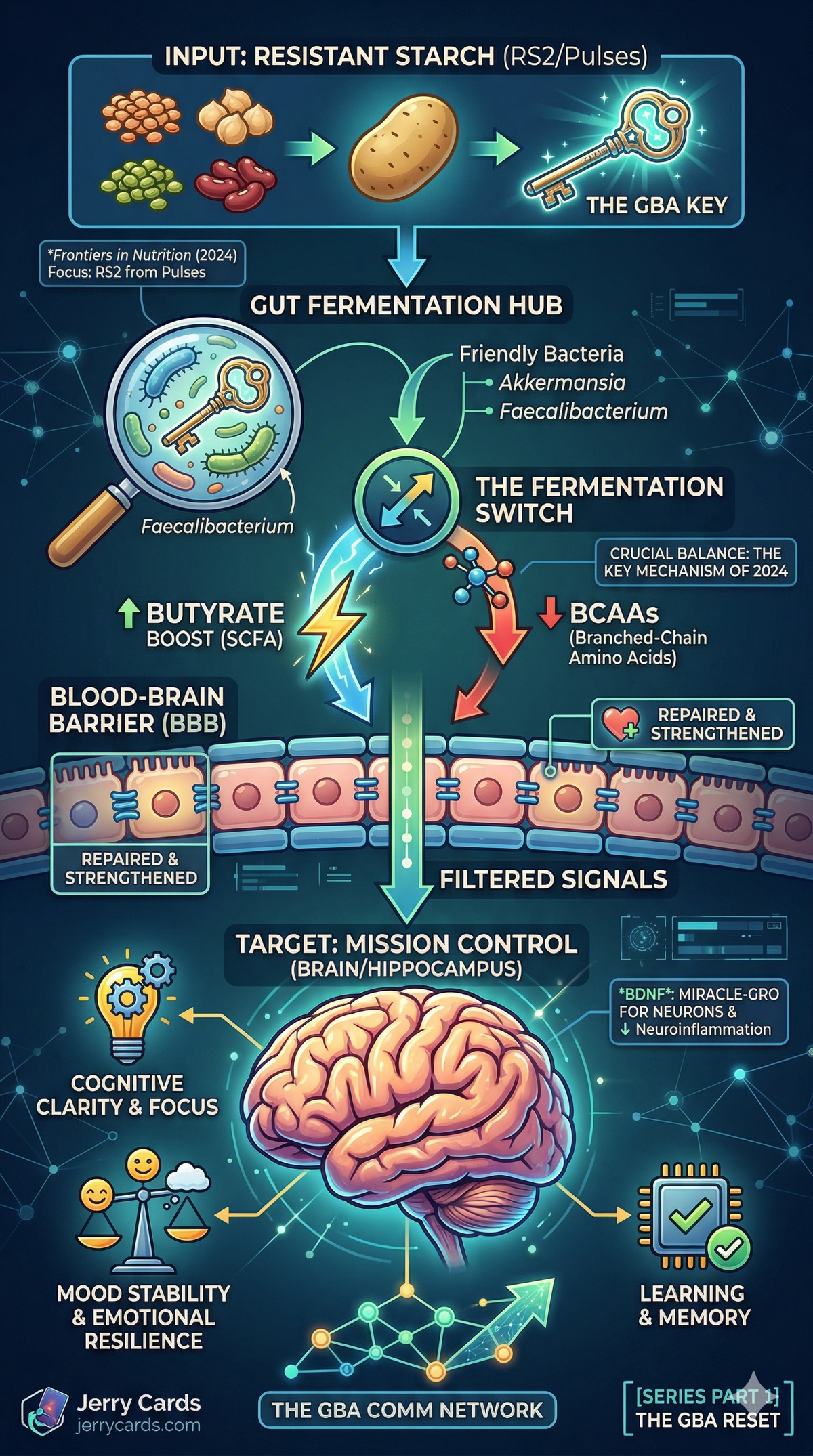
We often talk about "Gut Feelings," but the latest science suggests your gut is actually the mission control for your brain’s clarity and emotional resilience. This is Part 1 of our Resistant Starch series — and we’re starting with the most impactful study in the field.
The Study
Paper: Resistant starches from dietary pulses improve neurocognitive health via gut-microbiome-brain axis in aged mice
Authors: Kadyan S, Park G, Hochuli N, Miller K, Wang B, Nagpal R
Institution: Florida State University
Journal: Frontiers in Nutrition, Volume 11, January 2024
DOI: 10.3389/fnut.2024.1322201 (Open Access)
Why This Paper Matters
This isn’t another "eat your vegetables" study. It’s a rigorous 20-week intervention that maps the complete signaling pathway from what you eat, through your gut bacteria, to measurable changes in your brain’s inflammation, growth factors, and cognitive performance.
What is Resistant Starch? Unlike regular starch (which your body breaks down and absorbs as sugar), resistant starch "resists" digestion in the small intestine. It passes through to the large intestine intact, where specific bacteria ferment it. Think of it as precision fuel for your gut microbiome — not for you directly, but for the bacteria that control your health.
The Experimental Design
- Subjects: Aged mice (60 weeks old) carrying a humanized microbiome (transplanted human gut bacteria, making results more translatable to humans)
- Duration: 20 weeks
- Diet: Western-style diet (control) vs. the same diet fortified with 5% resistant starch from pinto beans, black-eyed peas, lentils, or chickpeas
- Tests: Morris water maze (spatial learning), Y-maze (working memory), novel object recognition (recall), plus anxiety and depression-like behavior tests
The Mechanism: How It Works
For the data-driven minds, here is the complete input-output pathway:
| Step 1: Fermentation | Resistant starch passes through the small intestine undigested. In the large intestine, it is fermented by specific bacteria — particularly Akkermansia and Faecalibacterium (known butyrate producers) |
| Step 2: Metabolite Surge | Fermentation triggers a massive spike in Butyrate (a short-chain fatty acid) and a significant drop in BCAAs (branched-chain amino acids). Both changes are measurable in feces and blood serum. |
| Step 3: Barrier Repair | Butyrate repairs and strengthens both the gut barrier (preventing "leaky gut") and the Blood-Brain Barrier (BBB). Tight junction proteins ZO-1 and Occludin are upregulated. |
| Step 4: Brain Effects | Neuroinflammation markers (IL-6, TNF-α) drop in the hippocampus. BDNF (Brain-Derived Neurotrophic Factor) increases — essentially "Miracle-Gro" for your neurons. Serum leptin and insulin levels normalize. |
| Result | Significantly improved spatial learning (Morris water maze), working memory (Y-maze), recognition memory (novel object), and reduced anxiety/depression-like behaviors. All p < 0.05. |
The Formula
Resistant Starch → Gut Fermentation → ↑Butyrate + ↓BCAAs → Repair Gut Barrier + Blood-Brain Barrier → ↓Neuroinflammation + ↑BDNF → Better Cognition & Stable Mood
Which Type of Resistant Starch Worked Best?
Of the four pulse sources tested, lentils showed the strongest neuroprotective effects, followed by black-eyed peas, chickpeas, and pinto beans. The researchers attribute this to lentils’ particularly high RS2 (Type 2 resistant starch) content and their specific fermentation profile.
Wait — This Was in Mice. Does It Apply to Humans?
Good question. Two important notes:
- The mice carried a humanized microbiome (transplanted human gut bacteria), making the results more translatable than typical rodent studies
- Multiple human clinical trials on resistant starch and gut health exist (we’ll cover these in Part 2 of this series), and they broadly support the same mechanisms
This study is the most complete mechanistic map of the RS → gut → brain pathway published to date. It’s the foundation on which human studies are being designed.
What’s Coming Next in This Series
- Part 2: Human clinical evidence — which populations benefit most?
- Part 3: RS2 vs. RS3 vs. RS4 — and why cooking then cooling your potatoes is a game-changer
- Part 4: A practical "Brain Sharpness" menu you can start today
Practical Takeaway
If you want to start feeding your butyrate-producing bacteria today:
- Lentils (the top performer in this study)
- Chickpeas and black-eyed peas
- Cooled potatoes and rice (cooking then cooling converts regular starch to RS3)
- Green bananas (high in RS2)
Sources: Kadyan et al., Frontiers in Nutrition (2024) — Full Paper (Open Access), PMC Full Text