
 العربية
 Español
 中文
中文 Deutsch
 Français
 Português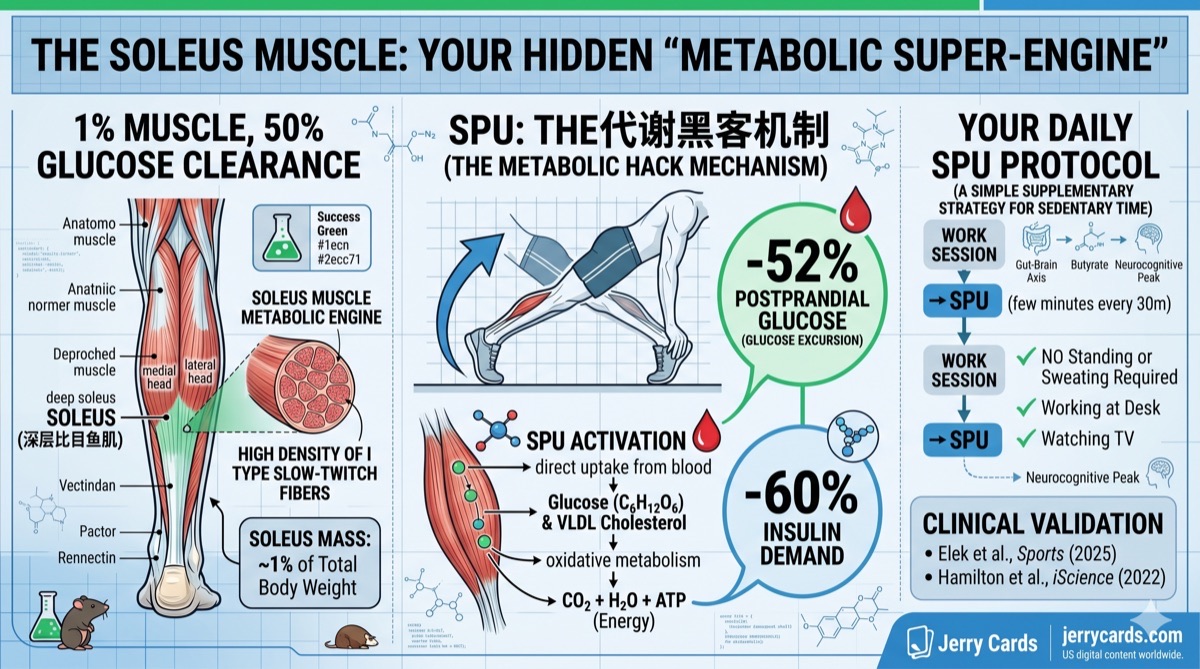
A 1% body-mass muscle in your calf can oxidize blood glucose at levels comparable to whole-body exercise - for hours, without fatigue, while you sit at a desk. The data is real, the mechanism is well-characterized, and there is now a human pilot study in prediabetics. This is a deep dive.
The Headline Result
Hamilton et al., iScience (August 2022): During a soleus-dominant contraction pattern performed while seated, the soleus muscle raised its local oxidative metabolism and sustained it for hours. Compared to sedentary controls performing the same oral glucose tolerance test:
- 52% lower postprandial glucose excursion (about 50 mg/dL less between 1 and 2 hours post-load)
- 60% lower hyperinsulinemia
- Minimal glycogen use - the muscle drew directly on circulating glucose and fatty acids
- Improved VLDL-triglyceride clearance
This is a remarkable physiological finding. A muscle weighing about 1 kg - one percent of an average adult's body mass - is being asked to do metabolic work that a standing human would typically split across the entire body. And it does it. Without fatigue. While the person sits still from the knee up.
1. Why the Soleus Is Different
The soleus is not just another leg muscle. It is anatomically specialized for sustained, postural, low-intensity work.

| Property | Soleus | Typical skeletal muscle |
| Type I slow-twitch fibers | 80 to 88% | 35 to 55% |
| Mitochondrial density | Very high | Moderate |
| Capillary density | Very high | Moderate |
| Myoglobin content | High | Lower |
| Primary fuel | Blood glucose and free fatty acids (oxidative) | Muscle glycogen (mixed) |
| Fatigue profile | Extremely fatigue-resistant | Fatigues within minutes at work rate |
The functional consequence: the soleus is built to take substrates from the bloodstream and oxidize them in real time, rather than drawing down local glycogen. This is the biological reason SPU does not fatigue the way a calf raise or squat does. The muscle is not burning its own reserves.
2. The Original Paper - Hamilton et al. 2022
Marc Hamilton and colleagues at the University of Houston published the foundational paper in iScience in August 2022: A potent physiological method to magnify and sustain soleus oxidative metabolism improves glucose and lipid regulation.
The study used a carefully designed seated contraction - what the authors call the Soleus Push-Up (SPU) - in which the heel rises while the forefoot stays planted, then drops passively. This is not a calf raise in the usual sense. It is specifically engineered to recruit the soleus while minimizing gastrocnemius involvement.
Key finding on metabolism: Hamilton reported that SPU raised local soleus oxidative metabolic rate to levels well above resting baseline, and sustained the effect for multiple hours. This is unusual - most physical activity either burns glycogen fast or cannot hold metabolic rate elevated for long periods.
3. Human Replication in Prediabetics - Elek et al. 2025
Until 2025, one legitimate critique of Hamilton's work was that the original study used tightly controlled laboratory conditions and EMG biofeedback. Could ordinary people produce the same effect without a lab?
Elek et al. published the first pilot answering this question in Sports (MDPI) in March 2025: The Efficacy of Soleus Push-Up in Individuals with Prediabetes: A Pilot Study.
| Element | Detail |
| Design | Within-subject crossover, 2-hour OGTT sedentary vs. 2-hour OGTT with SPU |
| Participants | n=10 (6 male, 4 female), mean age 53.3 +/- 2.7 years |
| Metabolic status | All met WHO prediabetes criteria. Fasting glucose 6.2 +/- 0.1 mmol/L |
| Intervention | Continuous SPU throughout 2-hour OGTT |
| Primary outcome | Glucose incremental area under the curve (iAUC) |
| Overall glucose iAUC reduction | About 32% |
| With EMG biofeedback | 37% iAUC reduction |
| Without EMG biofeedback | 26% iAUC reduction |
| Statistical significance | Significant glucose reductions observed from the 30-minute mark onward (p less than 0.05 to p less than 0.001 at various timepoints) |
The key finding for real-world application: the effect was present even without EMG biofeedback. A 26% reduction in postprandial glucose excursion is a large effect, and it was achieved with participants simply instructed in the motion. No lab equipment. No personal trainer. No gym.
4. Mechanism - Why the Soleus Is Unique
A normal muscle contraction pulls on ATP, which is regenerated primarily from muscle glycogen via glycolysis. Glycogen is limited - roughly 400 to 500 grams total across all skeletal muscle in a typical adult. When it runs low, you fatigue.
The soleus, under SPU-style low-intensity sustained contraction, operates differently:
- GLUT4 translocation via contraction - muscle contraction itself (independent of insulin) moves glucose transporters to the cell membrane, pulling glucose directly from blood into the muscle fiber.
- Free fatty acid uptake - Type I fibers have high fatty acid oxidation capacity. The soleus simultaneously pulls FFAs from blood.
- Oxidative phosphorylation - with extensive mitochondria, these substrates are fully oxidized to CO2 and water, generating large amounts of ATP per substrate molecule.
- Capillary and myoglobin oxygen supply - the dense capillary bed and high myoglobin content mean oxygen never becomes limiting.
- Glycogen spared - because the muscle runs almost entirely on blood-borne substrates, its glycogen stays intact. No glycogen depletion means no fatigue.
The net effect: while SPU is happening, the soleus is acting as a real-time glucose and lipid disposal organ. Your blood glucose goes down because it is being pulled into a working muscle and burned.
5. Why This Matters Clinically
Postprandial glucose excursion - the spike in blood glucose after eating - is one of the key drivers of microvascular damage in type 2 diabetes and prediabetes. Reducing it is not cosmetic. Large postprandial spikes correlate with:
- Endothelial dysfunction (lining of blood vessels damaged)
- Accelerated atherosclerosis
- Oxidative stress in neurons (relevant to Alzheimer-type pathology)
- Pancreatic beta-cell stress (accelerating progression from prediabetes to diabetes)
- Increased advanced glycation end-product (AGE) formation
A 32 to 52% reduction in postprandial glucose excursion - if sustainable long-term - is in the same order of magnitude as pharmaceutical interventions like metformin or GLP-1 receptor agonists, but without the side effects and without the cost.
6. The Protocol
How to Perform the Soleus Push-Up
- Position: Sit in a chair with feet flat on the floor, knees at 90 degrees. Shoes on or off - does not matter.
- Setup: Keep your toes firmly planted on the floor. This is critical. If the toes lift, you are doing a calf raise - which recruits the gastrocnemius, not the soleus.
- Up phase: Slowly raise your heels as high as they go while keeping toes down. Feel the deep calf muscle (not the surface bulge) tense.
- Down phase: Let the heels drop passively. Do not press down actively.
- Rhythm: Natural, relaxed pace. No strain. No burn. If it burns, you are overdoing it - slow down.
- Duration: Starting point - 2 to 3 minutes every 30 minutes of seated time. Can extend to hours if desired.
7. What SPU Is Not
This is a good point to separate SPU from related but distinct interventions:
| Intervention | Primary effect | Vs. SPU |
| Calf raises | Gastrocnemius strengthening, glycogen burn | Different muscle, different fuel, fatigues fast |
| Standing desk | NEAT increase via postural muscles | Smaller metabolic magnitude, does not specifically activate soleus oxidatively |
| Walking | Whole-body oxidative + glycolytic | Larger effect, but cannot be sustained for hours while working |
| Soleus push-up | Targeted soleus oxidative activation, blood-substrate burn | Sustainable for hours, compatible with seated work |
8. Integration With Our Prior Research Series
Regular readers will recognize a pattern. Multiple independent research lines keep converging on the same endpoint - mitochondrial glucose and fat oxidation:
| Resistant Starch (RS3) | Butyrate from gut fermentation - fuels mitochondria via the gut-brain axis |
| FTL1 Protocol | NMN, CoQ10, iron management - keep mitochondrial ATP output high |
| Exercise | PGC-1 alpha - creates new mitochondria (biogenesis) |
| Soleus Push-Up | Real-time oxidative disposal of blood glucose and fatty acids during sedentary time |
Four interventions. Four different entry points. One convergent target: keep your cells energized and your blood substrates low. SPU is the one that works specifically during the hours you are stuck sitting.
9. Caveats and Open Questions
- Sample sizes remain small. The Hamilton 2022 study had a modest laboratory cohort. Elek 2025 had n=10. Larger RCTs are in progress but not yet published.
- Long-term adherence unknown. Whether people will continue SPU for months and years is an open behavioral question.
- Technique matters. If you lift toes off the floor, you are doing a calf raise. If your calf burns and fatigues, you are using gastrocnemius. The soleus-specific pattern is subtle.
- Not a replacement. SPU does not replace structured exercise, healthy diet, or medication when indicated. It is a complement - specifically for the many hours of seated time most adults cannot avoid.
- Medical supervision. If you are on insulin or sulfonylureas, dramatic reductions in postprandial glucose can interact with your medication dosing. Talk to your physician before relying on SPU for glycemic control.
10. The Practical Takeaway
The 30-minute rule: For every 30 minutes of seated time, do 2 to 3 minutes of soleus push-ups.
Post-meal: Do SPU continuously for the first 60 to 90 minutes after eating.
Technique: Toes down. Heels slowly up. Passive drop. No burn.
Expectation: 25 to 50 percent reduction in postprandial glucose spikes in metabolically healthy-to-prediabetic adults.
Sources and Further Reading
- Hamilton et al., iScience (2022): A potent physiological method to magnify and sustain soleus oxidative metabolism improves glucose and lipid regulation
- Elek et al., Sports (2025): The Efficacy of Soleus Push-Up in Individuals with Prediabetes: A Pilot Study
- EurekAlert: Discovery - Special muscle can promote glucose and fat burning while sitting
- Marc Hamilton interviewed on IHMC STEM-Talk (Episode 162)
- Jerry Cards: The FTL1 Protocol (related mitochondrial intervention)
- Jerry Cards: Resistant Starch and the Gut-Brain Axis
Nothing in this article constitutes medical advice. It is a summary of published research. Consult your physician before changing your management of prediabetes or diabetes.