
 العربية
 Español
 中文
中文 Deutsch
 Français
 Português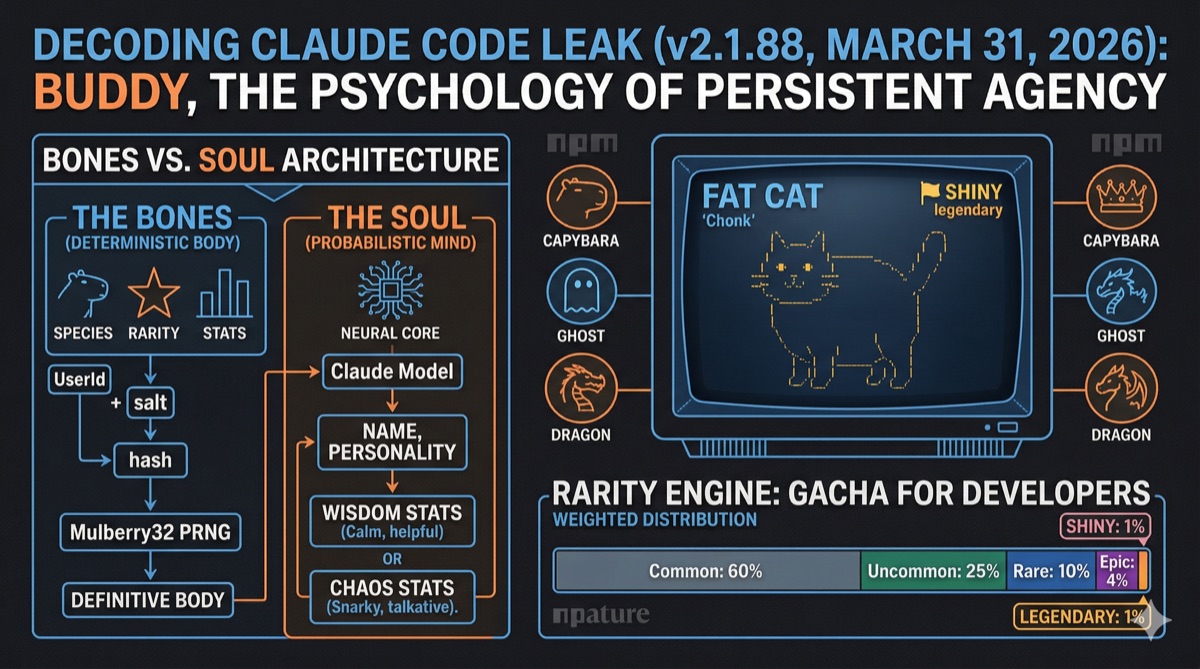
This is Part 5 (Final) of our 5-part series: "The Architecture of Agency." Part 1: the harness. Part 2: the model roadmap. Part 3: KAIROS daemon. Part 4: prompt compilation. Now we conclude with the most unexpected discovery in the entire 512,000-line codebase.
While the rest of Claude Code is serious infrastructure — high-performance runtimes, security architectures, autonomous daemons — the src/buddy/ directory reveals something entirely different: a high-effort, collectible digital pet system with the sophistication of a AAA video game’s gacha engine.
To a casual observer, it’s an April Fools’ Easter egg (the feature leaked on March 31, one day before its intended April 1 launch). To a researcher, it’s a masterclass in agentic persistence and identity design.
1. The Dual Architecture: "Bones" vs. "Soul"
Every Buddy is composed of two distinct layers, each generated by a completely different mechanism:
| Layer | Generation | What It Determines | Persistence |
| Bones | Deterministic (Mulberry32 PRNG) | Species, rarity, shiny status, base stats, eye style, hat | Never stored — recomputed from identity hash every session |
| Soul | Probabilistic (Claude model) | Name, personality description, behavioral quirks | Written to ~/.claude.json on first hatch |
1.1 The Bones Layer: Deterministic Identity
The Bones layer is the foundation — and it’s entirely deterministic. Here’s the exact generation pipeline:
- Input: Your account UUID is concatenated with the salt string
'friend-2026-401' - Hash: The combined string is run through FNV-1a hashing (32-bit)
- Seed: The hash becomes the seed for a Mulberry32 PRNG (a fast, deterministic pseudo-random number generator)
- Output: The PRNG generates all Bones attributes: species, rarity tier, shiny flag, stats, visual elements
The Critical Design Choice: Bones are never persisted to disk. They are recalculated from your identity hash at the start of every session. Even if you manually edit ~/.claude.json, the Bones layer regenerates from scratch. This means: you cannot hack, reroll, or fake your Buddy. Your userId deterministically produces one and only one pet, forever.
1.2 The Soul Layer: AI-Generated Personality
When you first execute /buddy to trigger "hatching," the Claude model receives your pet’s Bones attributes and generates:
- A name that fits the species and personality
- A personality description based on the stat distribution
- Behavioral quirks that influence how the pet "speaks" in your terminal
A Buddy with high WISDOM stats gets a calm, introverted persona. One with high CHAOS becomes a snarky chatterbox. The Soul is stored in the companion field of ~/.claude.json for persistence across sessions.
2. The Rarity Engine: Gacha Mechanics for Developers
The rarity system would look at home in a AAA mobile game’s gacha engine:
2.1 Rarity Distribution
| Tier | Probability | Visual Indicator |
| Common | 60% | Standard appearance |
| Uncommon | 25% | Slightly enhanced |
| Rare | 10% | Distinctive features |
| Epic | 4% | Special effects |
| Legendary | 1% | Unique animations, special hat |
Additionally, there is an independent 1% Shiny flag that can trigger on any species at any rarity tier. This makes a "Shiny Legendary Capybara" a 1-in-10,000 occurrence — rarer than most competitive game collectibles.
2.2 The 18 Species
Spread across 14 thematic categories:
| Classic | Duck, Goose, Cat, Rabbit |
| Wise / Cool / Chill | Owl, Penguin, Turtle, Snail |
| Mythical / Aquatic / Exotic | Dragon, Octopus, Axolotl |
| Spooky / Tech / Abstract | Ghost, Robot, Blob |
| Plant / Fungi / Meme / Special | Cactus, Mushroom, Chonk (Fat Cat), Capybara |
Note the deliberate inclusion of "Capybara" as a species — the same codename used for Claude Mythos (Part 2). This is either an inside joke or a clever cross-reference between the pet system and the model roadmap.
3. The Stats System: Personality as Computed Attribute
Every Buddy receives five stats on a 0–100 scale, generated by the Mulberry32 PRNG:
| Stat | What It Influences |
| DEBUGGING | How helpful the pet is during error diagnosis |
| PATIENCE | Tolerance for long, repetitive tasks |
| CHAOS | Tendency toward unpredictable, snarky commentary |
| WISDOM | Calm, thoughtful personality; reflective responses |
| SNARK | Dry humor, witty observations about your code |
The generation algorithm picks one peak stat and one dump stat, creating distinctive personality profiles. A high-CHAOS, low-PATIENCE Buddy will behave very differently from a high-WISDOM, low-SNARK one.
4. Visual Design: ASCII Art in Your Terminal
The visual implementation is surprisingly detailed for a terminal application:
- Canvas: 5 lines high, 12 characters wide
- Animation: 3 idle frames per species, refreshed every 500 milliseconds
- Customization: 6 eye styles (· ✦ × ◉ @ °) and 7 hat options (Crown, Top Hat, Wizard Hat, Halo, Propeller Hat, Beanie, and a duck-on-head)
- Shiny indicator: Shiny variants display with sparkle effects in the ASCII art
5. The Community Response
The Buddy system leaked on March 31 — one day before its intended April 1 launch. Within 48 hours, the developer community had:
- Created claude-buddy.vercel.app — a web gallery showing all 18 species with their ASCII art
- Built a Buddy previewer tool where you input a userId to see what pet you’d get
- Filed a GitHub Issue on Anthropic’s repository requesting an RPG evolution system
- Started trading screenshots of rare Buddies on social media
6. The Deeper Purpose: Identity Anchors for Persistent Agents
Why did Anthropic spend thousands of lines of code on a terminal pet? The answer connects directly to KAIROS (Part 3) and the broader agentic strategy.
Problem: An always-on agent that lives in your workspace and acts autonomously (KAIROS) can feel invasive. Users may resist a "ghost" in their terminal.
Solution: Give the agent a face. A friendly face. A face you chose (or rather, that chose you). A face that’s persistent, unique, and slightly collectible.
Result: The Buddy transforms an invisible background process into a companion. You don’t "run a daemon"; you have a pet that helps you code. The psychology shifts from surveillance to partnership.
6.1 Three Functions of the Identity Anchor
| Visual Presence | An always-on agent is invisible and potentially creepy. A Buddy provides a visible, friendly avatar for the background process. You can see "who" is helping you. |
| Session Continuity | By making the pet deterministic and persistent, Anthropic trains users to expect their AI to remember them across sessions, machines, and reinstalls. The Buddy is always there, always the same. |
| Engagement & Retention | The gacha mechanics (rarity, shiny variants) create social sharing and long-term engagement. Users don’t just use Claude Code; they show off their Legendary Capybara on Twitter. |
6.2 The Statistical Perspective
From a data science viewpoint, the Buddy system is a massive A/B test for user retention. By using a deterministic hash (userId + salt), Anthropic has created an "un-hackable" collectible system that:
- Provides a measurable proxy for user identity strength (users who hatch their Buddy are more invested)
- Creates social proof (rare Buddies become status symbols in developer communities)
- Tests persistence infrastructure (the same Bones/Soul split could power more serious agent memory systems)
7. Series Conclusion: The Blueprint of Agency
Over five parts, we’ve decoded the complete architecture of the world’s most advanced AI coding agent:
| Part 1 | The Harness — Bun runtime, 4-stage context pipeline, YOLO classifier |
| Part 2 | The Roadmap — Mythos/Capybara, ULTRAPLAN, Undercover Mode |
| Part 3 | KAIROS — Always-on daemon, 15-second budget, autoDream |
| Part 4 | Prompt Compilation — DANGEROUS_uncached, context poisoning, anti-distillation |
| Part 5 (This Post) | Buddy — Tamagotchi identity anchors, Mulberry32 gacha, persistence |
The Overarching Lesson: The future of AI isn’t just about building smarter models. It’s about building the entire system around the model: the harness that controls it, the daemon that persists it, the prompt compiler that feeds it, and the friendly face that makes humans trust it. Claude Code’s 512,000 lines prove that the moat in AI is engineering, not intelligence.
Sources: