
 العربية
 Español
 中文
中文 Deutsch
 Français
 Português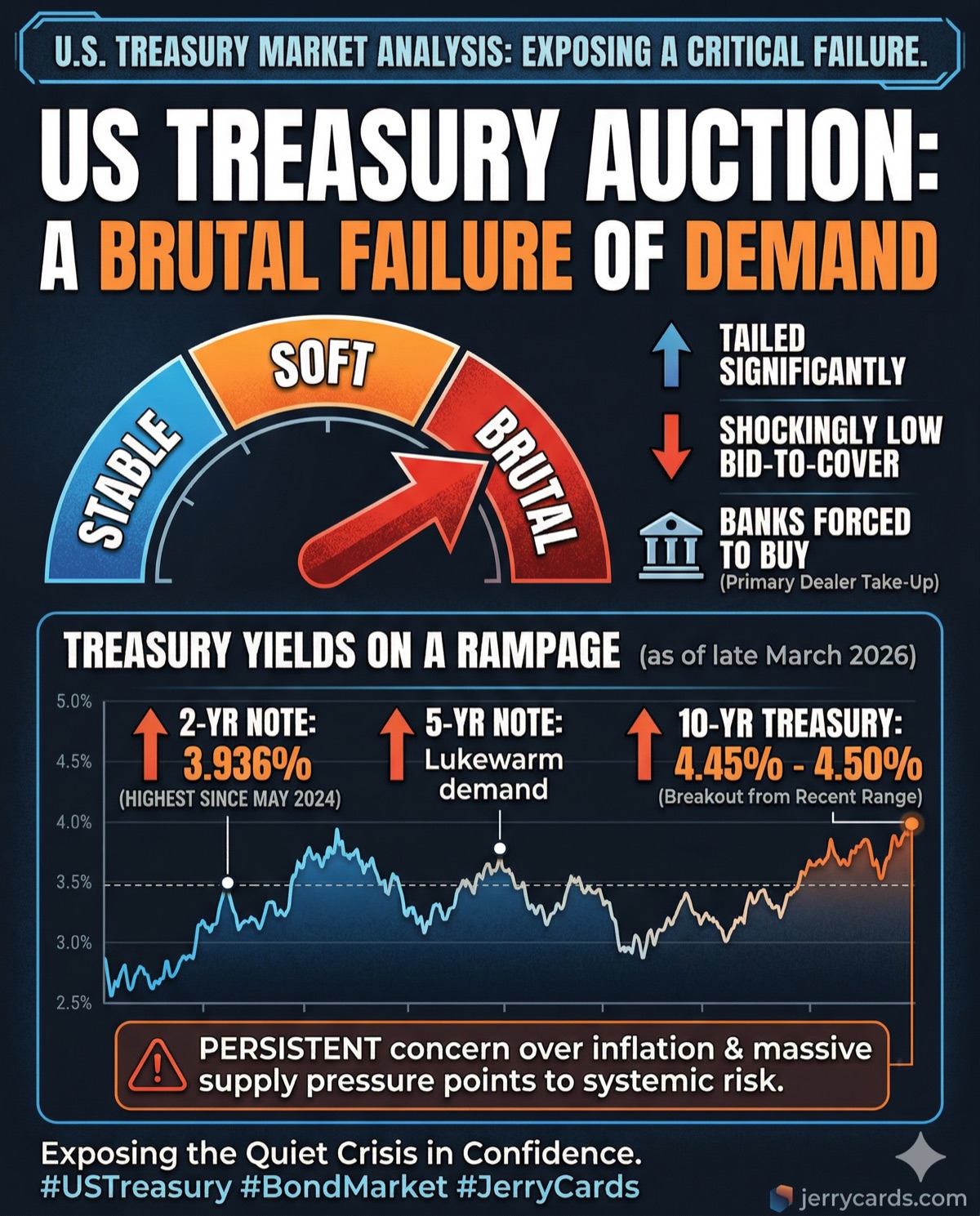
The March 24–26, 2026 US Treasury auctions sent a clear signal: investor confidence in US government debt is eroding. All three key auctions — the 2-year, 5-year, and 7-year notes — "tailed" significantly, meaning the government had to offer higher yields than expected just to sell its debt.
This isn’t a temporary blip. It’s a structural repricing.
Wait — Why Are Rising Yields Bad? (The Counter-Intuitive Part)
If you’re not in finance, "yields are rising" sounds positive — like you earn more on your savings. It’s actually the opposite. Here’s why:
Think of it this way: The US government is like a borrower asking for a loan. When investors lose confidence, they demand a higher interest rate (yield) to lend their money. This is like your credit score dropping — you pay more to borrow.
When the government’s borrowing costs rise, everyone’s costs rise — because Treasury yields are the baseline for all interest rates in the economy.
| Your Mortgage | Mortgage rates track the 10-year yield. A 50bp rise = ~$150/month more on a $400K home. |
| Your Auto Loan | Car loan rates rise, making vehicles more expensive to finance. |
| Corporate Layoffs | Companies borrow to grow. Higher rates = slower growth = hiring freezes and layoffs. |
| Stock Prices | Higher yields make bonds relatively more attractive vs. stocks, compressing equity valuations. |
| Government Spending | The US already pays over $1 trillion/year in interest. Higher rates mean even more goes to interest, leaving less for defense, healthcare, infrastructure. |
The Auction Data (Official TreasuryDirect Results)
2-Year Note — March 24, 2026 ($69 Billion)
- Demand: Weakest since March 2025
- Yield: Surged to 3.96% (up 10 basis points)
- Investors spurned the auction amid concerns that a protracted Middle East conflict will drive an oil-fueled resurgence in inflation
5-Year Note — March 25, 2026 ($70 Billion)
| High Yield | 3.980% |
| Median Yield | 3.923% |
| Bid-to-Cover Ratio | 2.29 (below the ~2.4 average — indicates weak demand) |
| Allotted at High | 89.88% (most bidders demanded the highest yield) |
| Primary Dealer Take-Up | $10.9B accepted out of $90.2B tendered (dealers are backstop buyers — high dealer allocation = weak real demand) |
| Indirect Bidders (Foreign Central Banks, etc.) | $43.2B accepted (61.9% — below recent averages) |
| Direct Bidders | $15.7B accepted (22.5%) |
Source: TreasuryDirect Official Results (PDF)
10-Year Treasury Yield
The collective weakness across these auctions pushed the benchmark 10-year yield toward 4.45% – 4.50%, breaking out of its recent range. This is the single most important number in global finance — it sets the floor for mortgage rates, corporate bonds, and government borrowing costs worldwide.
Key Terminology Explained
"Tailed" — When the auction’s high yield (the rate the government actually pays) is significantly above the when-issued yield (what the market expected). A tail means the government had to pay more than expected. It’s like listing your house at $500K but having to accept $480K.
"Bid-to-Cover Ratio" — Total bids divided by total amount sold. A ratio of 2.5+ is healthy (meaning $2.50 of demand for every $1 of supply). Below 2.3 signals weak demand.
"Primary Dealer Take-Up" — Primary dealers (big banks like JPMorgan, Goldman Sachs) are required to bid at every auction. When they end up buying a large share, it means real investors (pension funds, foreign central banks) didn’t show up. Think of it as the auctioneer’s friends buying the unsold items.
Why Is This Happening Now?
- The "Safe Haven" Trade Is Broken: Normally, geopolitical tension (US military engagement in Iran) sends investors into Treasuries. Instead, the Middle East situation is driving up oil prices, fueling inflation fears, making bonds toxic to hold. Inflation erodes the fixed payments bonds provide.
- The Supply Avalanche: US national debt exceeds $39 trillion. Trillions more must be refinanced this year. Investors are calculating the probability that the Treasury is hitting a wall where demand simply cannot keep up with supply.
- Fed Rate Uncertainty: With inflation resurgent, rate cuts are off the table. The market is now pricing in the possibility that rates stay higher for even longer than expected.
The Bottom Line
We are witnessing a quiet, brutal crisis in confidence. The "safest asset in the world" isn’t as safe as it was a week ago. Rising yields are a tax on the entire economy — from your mortgage payment to your company’s ability to hire.
This isn’t a temporary geopolitical issue. It’s a sign of deeper, systemic concerns about US fiscal sustainability in 2026.
Further Reading:
- Brookings: How to Tell If the Treasury Is Having Trouble Borrowing
- Thornburg: What Treasury Auctions Reveal
- Investopedia: Bid-to-Cover Ratio Explained
- Investopedia: What Are Treasury Yields and Why Do They Matter?
Sources: Bloomberg, TreasuryDirect (5-Year Auction PDF), CNBC