
 العربية
 Español
 中文
中文 Deutsch
 Français
 Português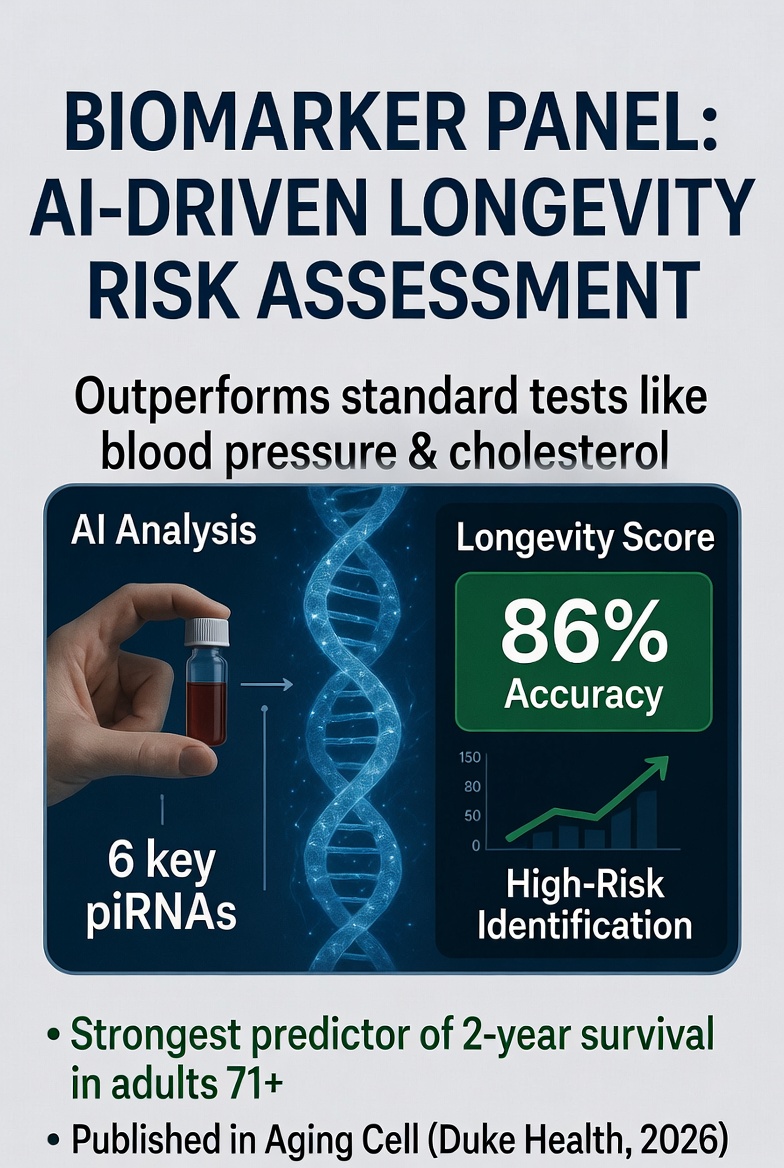
In a study that could fundamentally change how we think about aging, researchers at Duke Health and the University of Minnesota discovered that a simple blood test can predict whether older adults will survive the next two years with 86% accuracy.
The secret? Six tiny RNA molecules called piRNAs (PIWI-interacting RNAs) — now revealed as the most powerful biomarkers of human longevity ever identified.
How They Found It
The team used causal AI and machine learning to analyze:
- 1,200+ blood samples from older adults
- 187 clinical factors (age, blood pressure, cholesterol, BMI, medications, lifestyle)
- 828 different small RNA molecules
Just 6 piRNAs alone were the strongest predictor of 2-year survival — outperforming every traditional health measure.
Why piRNAs Are So Powerful
piRNAs regulate development, tissue regeneration, and immune response. The key finding: people who lived longer consistently had lower levels of specific piRNAs. This mirrors patterns in simpler organisms where reducing piRNA levels extends lifespan.
Better Than Everything Else
The 6-piRNA panel outperformed blood pressure, cholesterol panels, BMI, frailty assessments, and standard geriatric evaluations.
What This Could Mean
- Routine longevity screening from a simple blood draw
- Personalized treatment decisions for older adults
- Drug evaluation — fast way to test anti-aging drugs
- Eldercare planning with molecular-level insight
Can We Change the Score?
The team is now studying whether GLP-1 therapies (like Ozempic) can alter piRNA levels. If so, this test would not just predict your future — it could help change it.
Sources: Duke Health, US News, Newsweek, Science News