
 العربية
 Español
 中文
中文 Deutsch
 Français
 Português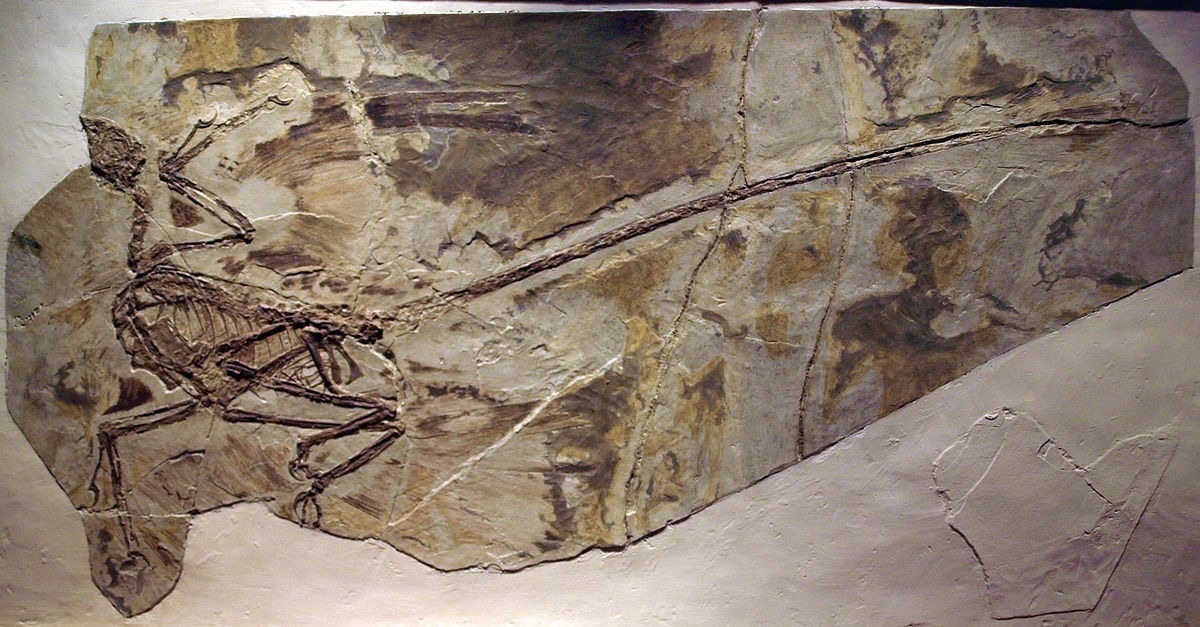
A single fossilized wing, 120 million years old, just gave paleontologists their prime suspect in one of the most curious cold cases in the fossil record. Buried in the rocks of northwestern China was a partial dinosaur shoulder and forelimb - essentially one wing - and from it, an international team has named a brand-new species: Jian changmaensis. It is a small, feathered cousin of Velociraptor, and it may finally explain why a nearby fossil site is littered with strange, crushed clusters of bird bones that look uncannily like the pellets a modern owl coughs up after dinner.
Here is the full story - what was found, how a single wing earns a mythological name, and why one bone can reopen a 120-million-year-old mystery.
- What: a new four-winged microraptorine dinosaur (family Dromaeosauridae - the group that includes Velociraptor)
- When it lived: Early Cretaceous, roughly 124-120 million years ago (lower Aptian)
- Where: Xiagou Formation, Changma Basin, Gansu Province, northwestern China
- The fossil: a single partial shoulder girdle and forelimb - effectively one wing
- Size: the largest microraptorine known, with an estimated ~4-foot (1.2 m) wingspan - about the size of a barn owl
- Why it matters: the first and only non-avian dinosaur at a site full of early birds, and the best suspect for mysterious crushed-bone pellets
- Published: Annals of Carnegie Museum, June 4, 2026 (vol. 92(2): 89-110)
1. A Site Full of Birds - and a Strange Clue
For years, one fossil locality near the village of Changma, in the Changma Basin of Gansu Province, has been a treasure trove for anyone studying the dawn of birds. It has produced more than a hundred exquisitely preserved Early Cretaceous bird skeletons, many with soft tissue, capturing a moment when feathered flyers were still sharing the skies with their dinosaur relatives.
But mixed in among those beautiful birds was something puzzling: strange clusters of shattered, pellet-like bird bones, compressed into dense little masses. To a modern eye they look eerily familiar - very much like the pellets that owls, hawks, and other birds of prey regurgitate after swallowing a meal whole and digesting the soft parts. Something had been eating these birds and leaving the bony remains behind. For a long time, no one could say what.
Modern raptors swallow prey whole, then cough up a compact pellet of indigestible bone, fur, and feathers. Paleontologists find fossilized pellet-like masses too - they are tiny time capsules of a predator's last meals. The clusters at Changma had the look of exactly this kind of leftover, which is why the “who made them” question was so tantalizing.
2. Meet the Suspect: Jian changmaensis
The new species changes the picture. Described by Ling-Qi Zhou, Matthew C. Lamanna, Ashley W. Poust, Da-Qing Li, Hai-Lu You, and Jingmai K. O’Connor, Jian changmaensis is the first - and so far only - non-avian dinosaur ever recovered from the site. Crucially, it was a carnivore, and far larger than anything else found there.
“Scientists have found these weird, broken-up clusters of bird bones at this site, and we didn’t know what made them,” said O’Connor, a paleontologist at the Field Museum in Chicago. This new microraptorine, the team concluded, is the best candidate for the predator responsible. As O’Connor put it, it “was the only dinosaur found at this site that wasn’t a bird, it was a carnivore, and it was much bigger than everything else that we’ve found there.”
Co-author Matthew Lamanna of the Carnegie Museum of Natural History underscored how lopsided the haul is: “Our team has recovered more than a hundred bird fossils at Changma, but only this single non-avian dinosaur specimen.” In an ecosystem brimming with small birds, Jian looks like the apex flyer in the room.
3. One Wing, One Mythical Name
The name is the poetry of this paper. The holotype - the single fossil that defines the species - is an isolated, partial pectoral girdle and forelimb. In other words, the entire animal is known, for now, from essentially one wing.
So the team reached into Chinese mythology. The genus name honors the Jian, a legendary one-winged bird that, in the old stories, must pair with a partner to fly. It is a perfect fit twice over: a nod to the bird-like, probably airborne nature of this little dinosaur, and a wink at the fact that its fossil is, quite literally, a lone wing. The species name, changmaensis, simply marks where it was found - Changma.
4. The Four-Winged Body Plan
Microraptorines are some of the most charming oddballs in the dinosaur family tree. Unlike almost everything else, they carried long, vaned flight feathers on both their arms and their legs - giving them, in effect, four wings. Their most famous member, Microraptor, is known from hundreds of specimens and remains the classic picture of the body plan.
What did they do with four wings? Probably not true, flapping flight. “Jian and the other microraptors probably weren’t capable of true, powered flight, but they could probably glide like a flying squirrel,” O’Connor explained - launching from a perch and sailing between trees, feathered limbs spread, to ambush prey or escape danger. For a predator hunting small birds in a forested wetland, gliding is a very effective way to get around.
| Feature | Jian changmaensis |
|---|---|
| Group | Dromaeosauridae → Microraptorinae (cousin of Velociraptor) |
| Age | ~124-120 million years (Early Cretaceous, lower Aptian) |
| Rock unit | Xiagou Formation, Changma Basin, Gansu, China |
| Holotype | Partial pectoral girdle + forelimb (one “wing”); humerus ~10 cm |
| Estimated size | Largest known microraptorine; ~4 ft (1.2 m) wingspan, barn-owl-sized |
| Likely lifestyle | Four-winged glider; bird-eating carnivore |
5. How a Single Bone Becomes a New Species
It is fair to ask: how do scientists name a new animal from a partial limb? The answer is autapomorphies - unique anatomical features found in no other known species. The Changma fossil carries a distinctive combination: a proportionally long coracoid (a shoulder bone) measuring about 36% of the humerus length, an unusual placement of the humeral condyles toward the front (cranial) surface, and a well-developed foramen on the underside of the bone. Taken together, these details set it apart from every previously described microraptorine - enough to justify a new genus and species.
A new species does not require a complete skeleton - it requires features that are demonstrably unique and diagnosable. Many beloved fossil animals were first named from fragments. The trade-off is honesty about uncertainty: a partial holotype means body size, proportions, and behavior are estimates, refined as more material turns up.
6. Why It Matters Beyond the Mystery
Solving the case of the crushed bird bones is the fun headline, but the deeper value is geographic and ecological. Microraptorines were thought to be concentrated in the famous Jehol Biota of northeastern China. Jian extends their confirmed range roughly 2,000 kilometers westward, showing these four-winged gliders ranged much farther across Early Cretaceous Asia than the fossil record had revealed.
It also enriches our picture of the world in which modern birds’ ancestors were finding their wings. “Jian provides critical new insight into the biological history of the Changma region and the ecological context of the ancestors of today’s birds,” Lamanna said. The site now reads less like a quiet bird sanctuary and more like a living ecosystem - small flyers below, a larger feathered predator gliding above.
What We Still Don't Know
- The predator link is a hypothesis, not a verdict. Jian is the best current candidate for the pellet-maker, but a direct connection (for example, identifiable bird bones inside a pellet matched to Jian) has not been demonstrated.
- The four-wing, gliding lifestyle is inferred. The holotype is a forelimb; leg feathers and gliding behavior are reconstructed from close relatives like Microraptor, not observed in this specimen.
- Size is an estimate. The “largest microraptorine” and ~4-foot-wingspan figures are scaled from a partial skeleton and may shift as more bones are found.
- More fossils are needed. A second, more complete specimen would test every one of these inferences - and may already be waiting in the Changma rocks.
The Takeaway
Jian changmaensis is a small fossil with a big personality: a one-winged relic named for a one-winged myth, a likely glider that hunted the earliest birds, and the missing piece in a 120-million-year-old whodunit. It is also a quiet lesson in how science works - a careful look at a single bone, a testable hypothesis, and an honest list of what remains unknown. Sometimes that is all it takes to reopen a very old case.
Sources
- Zhou, Lamanna, Poust, Li, You & O’Connor (2026). “First Non-Avian Theropod (Dromaeosauridae, Microraptorinae) from the Bird-Bearing Lower Cretaceous Xiagou Formation of the Changma Basin, Gansu Province, Northwestern China.” Annals of Carnegie Museum 92(2): 89-110. Full paper (PDF)
- EurekAlert! / Carnegie Museum of Natural History: New species of dinosaur, a cousin of Velociraptor, glided on four wings
- Sci.News: New Microraptorine Dinosaur Discovered in China
- SciTechDaily: New Feathered Dinosaur May Have Solved a 120-Million-Year-Old Fossil Mystery
- CNN: Rare fossil belonged to a gliding creature that hunted birds
Curated by Jerry Cards - jerrycards.com. We research the week’s most fascinating science, tech, and discovery news so you don’t have to. More at jerrycards.com/news.