
 العربية
 Español
 中文
中文 Deutsch
 Français
 Português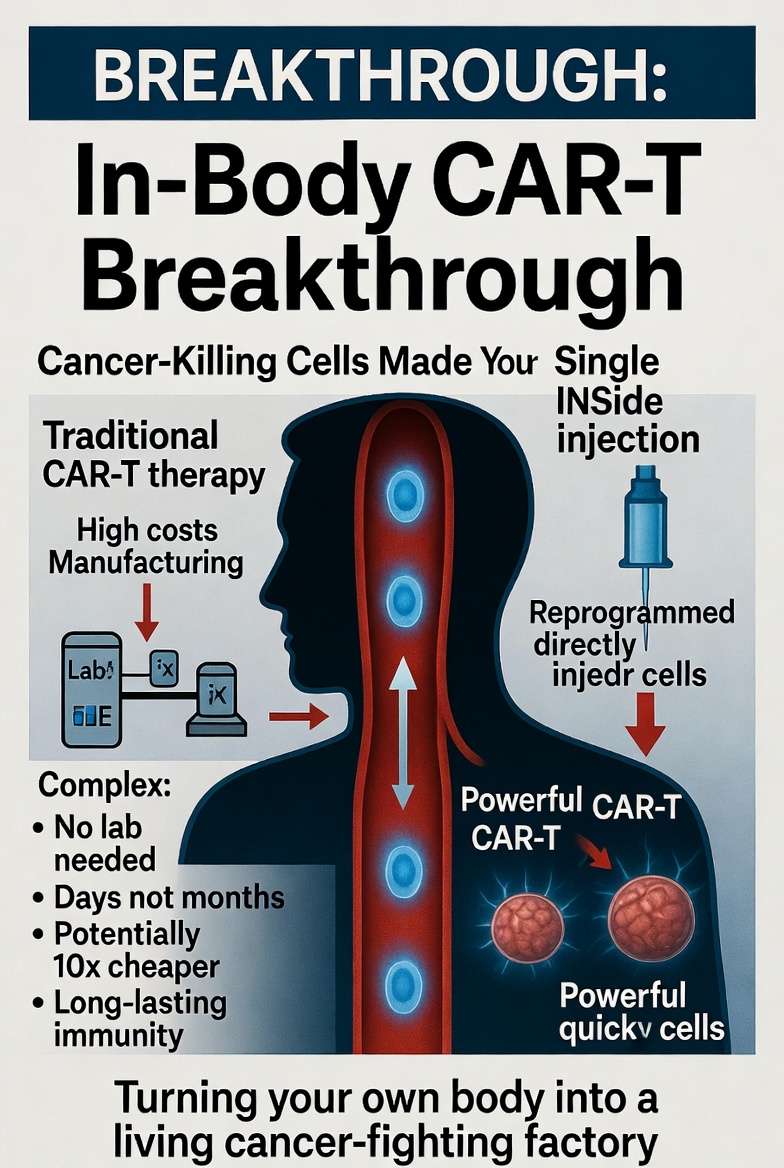
In one of the most significant advances in cancer treatment this decade, scientists at UC San Francisco and UC Berkeley have figured out how to turn the human body into a living CAR-T cell factory — engineering cancer-killing immune cells directly inside the bloodstream using a single targeted injection.
The research, published in Nature on March 18, 2026, demonstrates the first time scientists have successfully integrated a large sequence of DNA at a specific site in human T-cells without removing them from the body.
Why This Matters: The Problem with Current CAR-T Therapy
Current CAR-T cell therapy is one of the most powerful cancer treatments ever developed — it can cure some patients with blood cancers who had no other options. But it comes with enormous limitations:
- Cost: $400,000–$500,000 per patient
- Time: Weeks to months of manufacturing in specialized labs
- Process: T-cells must be extracted from the patient, shipped to a lab, genetically modified, expanded, and shipped back
- Preconditioning: Patients undergo harsh chemotherapy before receiving the cells
- Access: Only available at major cancer centers — excluding most patients worldwide
The Breakthrough: A Two-Particle System
The UCSF/Berkeley team designed an elegant two-particle delivery system:
- Particle 1: Carries CRISPR-Cas9 gene-editing machinery — the molecular scissors — directly to T-cells circulating in the bloodstream
- Particle 2: Delivers the cancer-targeting receptor (CAR) gene that tells the T-cells what to attack
Together, these particles find your T-cells in the blood, open up the right spot in their DNA, insert the cancer-targeting receptor, and transform them into powerful tumor destroyers — all happening inside your body, no lab required.
The Results: Better Than Expected
In experiments using mice with humanized immune systems, a single injection of the two-particle system produced remarkable results:
- Complete tumor elimination in nearly all mice within just 2 weeks
- Worked against three different cancer types: aggressive leukemia, multiple myeloma, and even a solid tumor
- Engineered CAR-T cells made up as much as 40% of immune cells in some organs
- No chemotherapy preconditioning needed
- Long-lasting immunity — the cells persisted and continued working
- Cancer was successfully eliminated from both bone marrow and spleen
Perhaps the most surprising finding:
"What was especially remarkable was that the cells we are generating in vivo actually look better than what we make in the lab." — Jacques Eyquem, UCSF researcher
The T-cells engineered inside the body unexpectedly outperformed those manufactured in traditional lab settings — a finding that challenges the assumption that controlled lab environments produce superior results.
What This Changes
If this approach translates to humans (clinical trials are being planned), it could fundamentally transform cancer treatment:
- Cost reduction: From $400K+ to potentially a fraction — no lab manufacturing needed
- Speed: Days instead of months from diagnosis to treatment
- Access: Could be administered at any hospital or clinic, not just major cancer centers
- Simplicity: A single outpatient injection rather than weeks of complex procedures
- Broader applications: The same gene-editing platform could target other diseases beyond cancer
Experts are calling it the potential "democratization" of CAR-T therapy — turning what was a boutique, last-resort treatment into something that could be as accessible as a flu shot.
Beyond Cancer
The implications extend far beyond oncology. This targeted in vivo gene-editing approach could potentially be applied to:
- Autoimmune diseases (engineering regulatory T-cells)
- Chronic infections (engineering pathogen-specific immunity)
- Genetic disorders (correcting genes in specific cell types)
- Transplant rejection (engineering tolerance)
The UCSF/Berkeley team's work represents a fundamental advance not just in CAR-T therapy, but in the broader field of cell and gene therapy — proving that precise genetic engineering can happen safely and effectively inside a living body.
The Road Ahead
Human clinical trials are still needed, and significant questions remain about safety, dosing, and long-term effects in humans. But the animal data is among the most promising ever published in this field.
As the researchers noted, this work was supported by the Innovative Genomics Institute (founded by Nobel laureate Jennifer Doudna) and builds on years of CRISPR gene-editing advances. The convergence of gene editing, immunotherapy, and targeted delivery is creating possibilities that were science fiction just a few years ago.