
 العربية
 Español
 中文
中文 Deutsch
 Français
 Português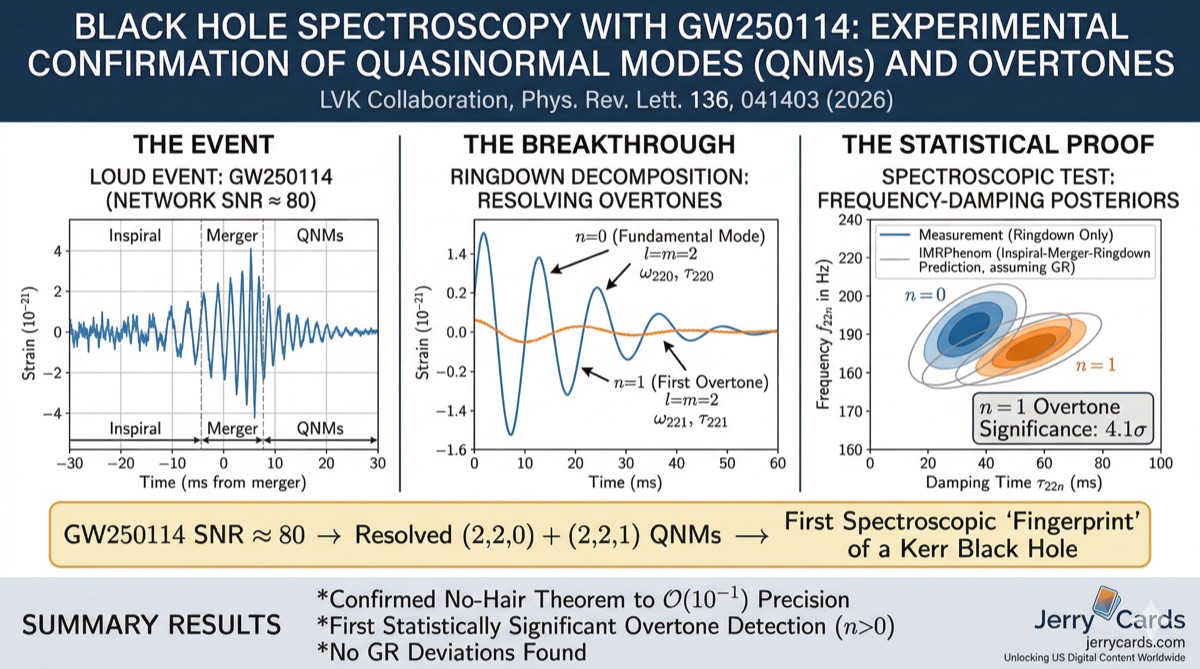
On January 14, 2025, the LIGO-Virgo-KAGRA (LVK) detector network recorded GW250114 — a gravitational wave signal from two merging black holes that shattered every previous record. With a signal-to-noise ratio (SNR) of approximately 80 (nearly double the previous best of 42 from GW230814), this event gave physicists an unprecedented window into the most extreme laboratory in the universe: the merger of two stellar-mass black holes.
The results, published in Physical Review Letters (Volume 136, Article 041403, January 30, 2026), represent the most stringent single-event test of General Relativity ever performed and the first true demonstration of black hole spectroscopy.
1. What Is Black Hole Spectroscopy?
The Analogy: When you strike a bell, it vibrates at specific frequencies determined by its material, size, and shape. If you can identify those frequencies, you can determine the bell’s properties without ever seeing it.
The Physics: When two black holes merge, the final remnant "rings" like a bell — emitting gravitational waves at frequencies called quasinormal modes (QNMs). According to the No-Hair Theorem, a black hole is fully characterized by just two numbers: its mass and spin. Therefore, every single QNM frequency must be mathematically derivable from those two parameters alone. If you can measure two or more independent modes and show they’re consistent with the same mass and spin, you’ve performed "spectroscopy" on the black hole — and confirmed it behaves exactly as Einstein predicted.
2. The Signal: GW250114
| Parameter | Value |
| Detection Date | January 14, 2025 |
| Network SNR | ~80 (previous record: ~42 for GW230814) |
| Progenitor Masses | ~34 M☉ + ~32 M☉ |
| Remnant Mass | ~63 M☉ (with ~3 M☉ radiated as gravitational waves) |
| Remnant Spin (a) | ~0.69 (dimensionless Kerr parameter) |
| Luminosity Distance | ~1.3 billion light-years |
| Signal Type | Binary black hole merger (BBH) with clearly resolved inspiral, merger, and ringdown phases |
3. Achievement #1: First Overtone Detection (ℓ = m = 2, n = 1) at 4.1σ
In all previous gravitational wave detections, only the fundamental quadrupolar mode (ℓ = |m| = 2, n = 0) could be clearly identified in the ringdown phase. This is the dominant vibration — the "loudest note" of the ringing black hole.
GW250114 changed this. The signal was powerful enough to resolve the first overtone (n = 1) at a significance of 4.1σ.
3.1 Why This Matters
A single mode measurement tells you a combination of mass and spin. You need at least two independent modes to separately determine both parameters and verify they’re consistent — which is the definition of spectroscopy.
The LVK team measured both the n=0 and n=1 modes and showed that their frequencies and damping times are consistent with the same Kerr black hole (same mass, same spin) to within 10–20% precision.
The No-Hair Theorem Test: If the overtone frequency had deviated from the Kerr prediction — even slightly — it would imply the remnant is not a Kerr black hole, which would mean either (a) General Relativity is wrong, or (b) the object has additional "hair" (properties beyond mass and spin). Neither happened. The No-Hair Theorem holds.
4. Achievement #2: Hawking’s Area Theorem Confirmation
In 1971, Stephen Hawking proved mathematically that the surface area of a black hole can never decrease (the second law of black hole mechanics, analogous to the second law of thermodynamics for entropy).
The test: calculate the total horizon area of the two progenitor black holes before merger, and compare it to the horizon area of the single remnant after merger.
| Pre-merger Area (sum of two BHs) | A₁ + A₂ = 4π(r₁² + r₂²) |
| Post-merger Area (remnant BH) | A_final = 4πr_final² |
| Result | A_final > A₁ + A₂ at >99.999% confidence |
While hints of this had been seen before (notably in GW150914), those analyses required combining data from multiple noisy events. GW250114 provides the first high-fidelity, single-event confirmation of Hawking’s area theorem.
5. Achievement #3: The Most Stringent Tests of General Relativity
The LVK team performed multiple parameterized tests of General Relativity across all three phases of the signal:
| Phase | What Was Tested | Result |
| Inspiral | Post-Newtonian coefficients (PN parameters) — do the orbiting black holes spiral inward as GR predicts? | Consistent with GR |
| Merger | Intermediate-regime coefficients — does the violent collision match numerical relativity simulations? | Consistent with GR |
| Ringdown | QNM frequencies and damping times — does the remnant ring as a Kerr black hole should? | Consistent with GR (4.1σ overtone) |
| Overall | Combined constraint tightness vs. previous catalog | 2–3x tighter than combining dozens of previous events |
Zero deviations from Einstein’s field equations were found at any stage.
6. The Gravitational Wave Memory Effect: Approaching the Frontier
General Relativity predicts a subtle effect called gravitational wave memory (Christodoulou memory): after a powerful gravitational wave passes, spacetime does not return exactly to its original configuration. There is a permanent, non-oscillatory displacement — a "dent" in the fabric of spacetime.
This effect is extremely difficult to detect because it manifests as a very low-frequency, DC-like shift in the detector signal. GW250114, being the loudest event ever, provides the best current sensitivity to this effect:
- Waveform models that include memory contributions fit the data better than models without them
- However, a standalone 5σ detection of the memory effect has not yet been claimed
- This remains a primary target for next-generation detectors: Cosmic Explorer, Einstein Telescope, and the space-based LISA mission
The BMS Connection: The memory effect is deeply connected to BMS symmetry (Bondi–van der Burg–Metzner–Sachs) — the infinite-dimensional symmetry group of asymptotically flat spacetimes. Detecting memory would provide experimental evidence for "soft hair" on black holes, a concept proposed by Hawking, Perry, and Strominger as a potential resolution to the Black Hole Information Paradox. GW250114 brings us closer to this frontier than any previous observation.
7. Why This Paper Is the "Golden Standard"
GW250114 is now the calibration benchmark for all future gravitational wave science:
- It establishes the baseline against which all future deviations from GR will be measured
- Its spectroscopic analysis provides the template for black hole fingerprinting at higher precision
- It validates the waveform models (IMRPhenom, SEOBNR) that will be used for the next decade of detections
- Researchers at the University of Miami have already used GW250114’s calibration to investigate a new signal (S251112cm) as a potential primordial black hole candidate — sub-solar-mass objects from the early universe that could only be identified against the precision standard set by this paper
8. What Comes Next
| LIGO O5 Run (2027+) | Increased sensitivity; expect more events at GW250114-class SNR for population-level spectroscopy |
| Cosmic Explorer | 10x sensitivity of current LIGO; will resolve multiple overtones on every merger |
| Einstein Telescope | Underground, triangular design; optimized for low-frequency signals including memory effect |
| LISA (2030s) | Space-based; supermassive BH mergers with SNR in the thousands; definitive memory detection |
The Bottom Line
One hundred years after Einstein published General Relativity, and ten years after the first gravitational wave detection, GW250114 has turned gravitational waves from whispers into precision instruments. We can now fingerprint a black hole by its vibrations, confirm that spacetime’s area always increases, and push toward the detection of permanent spacetime deformations.
Einstein’s theory has survived every test we’ve thrown at it. But with each louder signal, the resolution improves — and the probability that the next event reveals something new grows.
The universe is ringing. We’re finally learning to listen.
Sources: