
 العربية
 Español
 中文
中文 Deutsch
 Français
 Português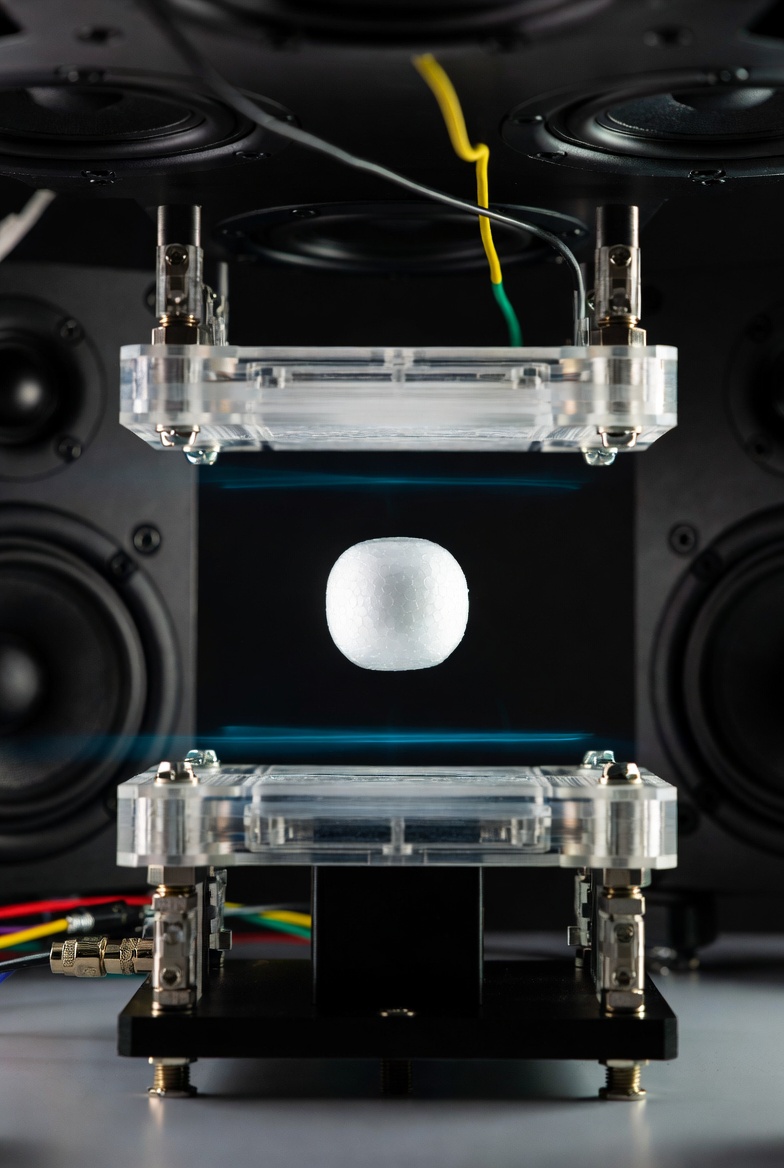
Physicists at NYU used ordinary sound waves to levitate tiny styrofoam beads in mid-air. What happened next challenged one of the most fundamental laws of physics.
The beads spontaneously began oscillating in perfect, self-sustaining rhythm. But here's the twist: the forces between them are completely one-sided. A larger bead pushes a smaller one harder than the smaller one pushes back. This violates Newton's Third Law — the principle that every action has an equal and opposite reaction.
How is this possible?
The interactions are carried by sound waves, not direct contact. In acoustics, forces can be nonreciprocal — meaning they don't have to be balanced. This allows the beads to enter a stable, rhythmic state that sustains itself indefinitely.
Why this matters:
- This is the first macroscopic, visible time crystal — previous ones required quantum systems at near absolute zero
- The entire device is about one foot tall and can be held in your hand
- Made from styrofoam and sound — radically simpler than any prior time crystal
- Could unlock new precision sensors, energy storage technologies
- May help scientists understand biological timing systems like circadian rhythms
The research was led by David G. Grier with Mia C. Morrell and Leela Elliott at NYU, published in Physical Review Letters.