
 العربية
 Español
 中文
中文 Deutsch
 Français
 Português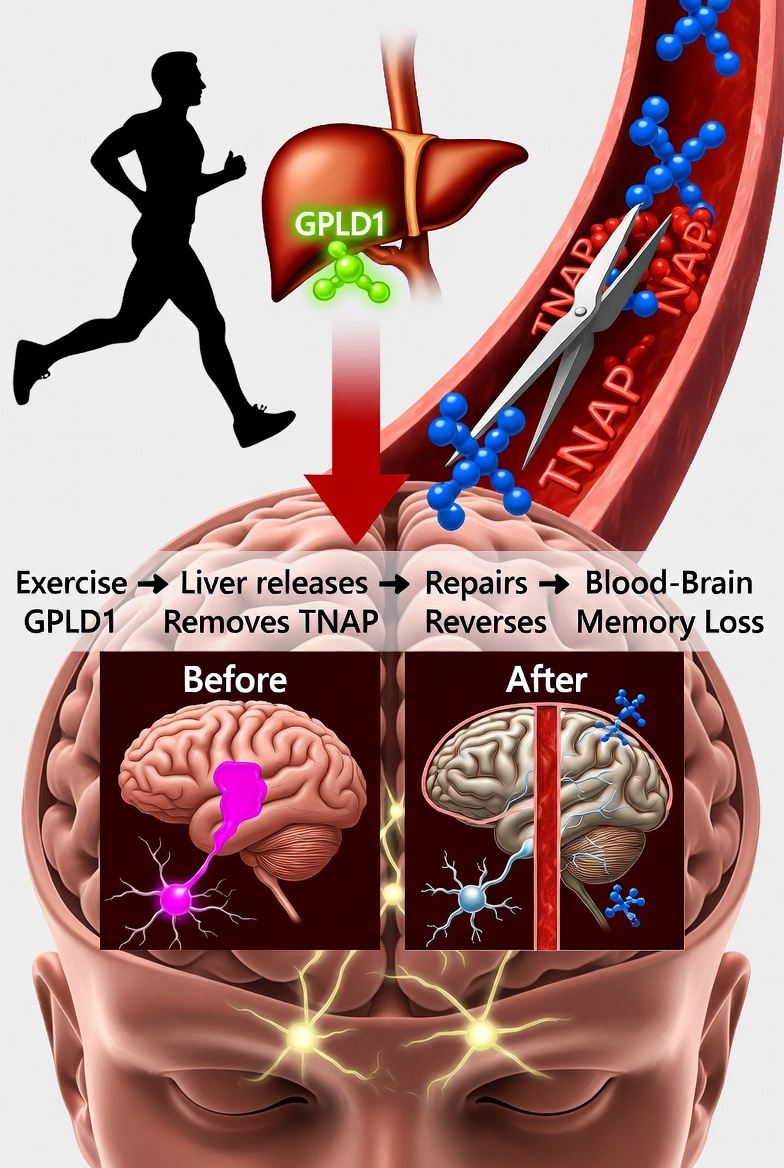
UCSF researchers (published in Cell, 2026) found that during physical exercise, the liver releases a protein called GPLD1 (an "exerkine"). This molecule circulates in the blood and travels to the brain, where it targets blood vessels.
The breakthrough mechanism:
As we age, a toxic protein called TNAP builds up on brain blood vessel walls. This makes the blood-brain barrier leaky, triggers inflammation, impairs nutrient delivery, and drives cognitive decline — a vicious cycle that worsens in Alzheimer's.
GPLD1 acts like molecular scissors: it precisely cleaves and removes excess TNAP from the vessel surface, restoring the barrier's strength and protecting the brain.
In aged mice and Alzheimer's disease models (treatment started even after decline had begun):
- Memory and learning abilities were restored toward youthful levels
- Blood-brain barrier leakage was dramatically reduced
- Amyloid plaque pathology and brain inflammation significantly decreased
- New neuron formation (neurogenesis) improved in the hippocampus
- Overall cognitive deficits were reversed
This is completely different from most current Alzheimer's approaches. Instead of targeting amyloid or tau directly inside the brain, it works through a peripheral liver-to-brain communication pathway — explaining one key reason why exercise is so protective.
The findings raise hope for new therapies that could deliver exercise-like brain benefits to people who cannot exercise.