
 العربية
 Español
 中文
中文 Deutsch
 Français
 Português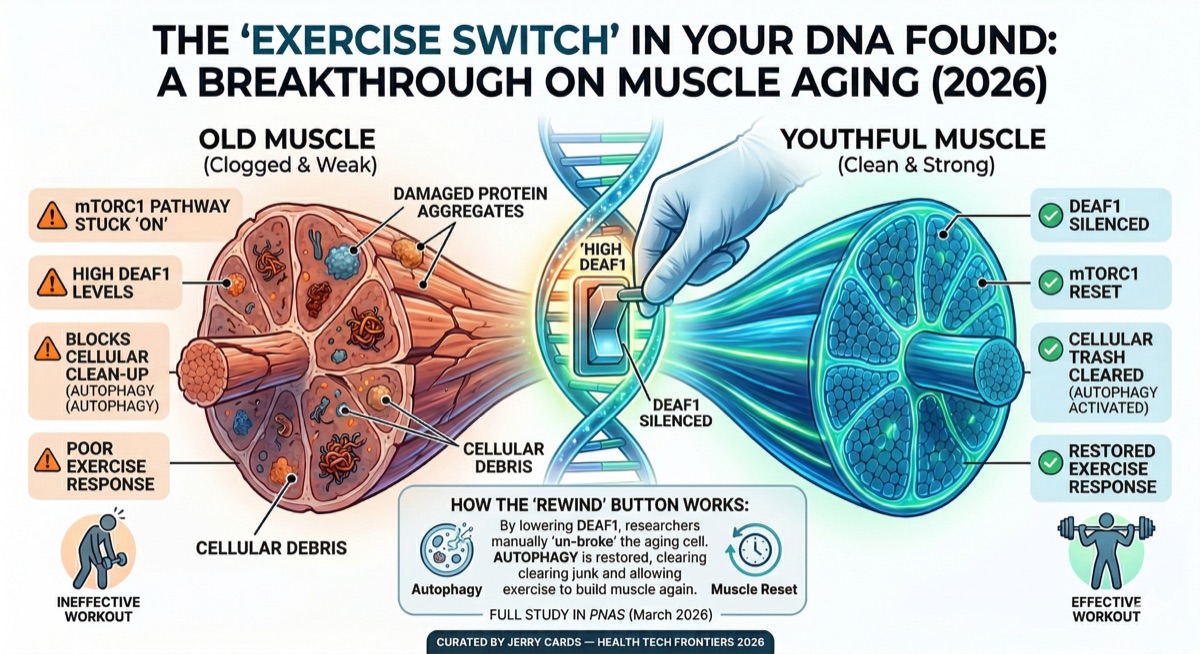
For decades, we have been told that exercise is the ultimate anti-aging tool. But for many people over 60, even daily gym sessions do not seem to stop muscle loss. We finally know why.
A groundbreaking study from Duke-NUS Medical School (published in PNAS) identified a gene called DEAF1 that acts as a molecular gatekeeper for muscle repair — and it is breaking down with age.
The Software Glitch Inside Your Muscles
Your muscles have a powerful growth engine called mTORC1. When you are young, it works perfectly: you exercise, mTORC1 turns ON to build muscle, then turns OFF so your cells can clean up damaged proteins. A beautiful cycle of build-clean-build.
As you age, something goes wrong. DEAF1 levels spike uncontrollably, pushing mTORC1 into permanent overdrive. The engine gets stuck in the ON position. Instead of the healthy build-clean cycle, your cells are constantly told to "build, build, build" — but they never get a chance to "clean, clean, clean."
The result: a buildup of molecular trash (damaged proteins) that weakens muscles from the inside. This is why aging muscles lose mass and strength even when you exercise regularly.
The FOXO-DEAF1-mTORC1 Axis
The research team identified the complete pathway:
- FOXO (longevity genes) act as the natural brake on DEAF1
- DEAF1 controls how aggressively mTORC1 runs
- mTORC1 drives muscle protein production and cell growth
- Autophagy (cellular cleanup) only works when mTORC1 turns OFF
In young muscles: Exercise activates FOXO → FOXO suppresses DEAF1 → mTORC1 cycles normally → autophagy cleans up → muscles stay healthy.
In aging muscles: DEAF1 is stuck high → mTORC1 never turns off → autophagy is blocked → damaged proteins accumulate → muscles weaken.
The Rewind Button
The most exciting finding: this is reversible. Using RNA interference (RNAi) to silence DEAF1, researchers restored muscle strength and resilience to youthful levels in lab models. They also achieved the same result by boosting FOXO proteins directly.
One of the most surprising discoveries was that exercise does this naturally. Physical activity lowers DEAF1 through FOXO activation. As the researchers noted: "In addition to building muscle, physical activity helps reset the core cellular pathways that keep muscles healthy."
The Over-40 Practical Guide
Based on the FOXO-DEAF1-mTORC1 pathway, here are evidence-based strategies to "reset the switch":
| Fasted HIIT | Forces FOXO activation in low-energy state, directly suppresses DEAF1. Do high-intensity intervals before breakfast. |
| 16:8 Time-Restricted Feeding | Un-sticks mTORC1 by allowing it to cycle OFF. Eat in a 8-hour window, fast for 16 hours. |
| Zone 2 Cardio (150+ min/week) | Steady-state aerobic exercise clears the protein buildup that triggers DEAF1 spikes. |
| Protein Pulsing | Eat protein in 2 large windows (not 6 small meals). Lets mTORC1 spike for growth then crash for cleanup. |
| Heavy Resistance Training | Overcomes the weakness signal from stuck DEAF1 through direct muscle fiber recruitment. |
The key insight: periodically simulate scarcity and intense stress. Be very anabolic (building) when you train and eat, and very catabolic (cleaning) during fasting and rest. The cycling is what resets the switch.
The Future: Exercise in a Pill?
Duke scientists are now working on drugs that could dampen DEAF1 or boost FOXO directly — essentially mimicking the molecular effects of exercise for people who cannot exercise due to injury, disability, or severe age-related decline.
Compounds like Spermidine are also being studied for their ability to trigger autophagy directly, potentially bypassing the broken DEAF1 signaling entirely.
The Bottom Line
Muscle loss with age is not just "wear and tear." It is a software glitch — a specific gene getting stuck in the wrong position. And like any software bug, it can be fixed.
The future of fitness is not just about moving more. It is about understanding the molecular reset buttons that keep our bodies young — and learning to press them.
Sources: PNAS (original paper), Duke University, EurekAlert, New Atlas, SciTechDaily