
 العربية
 Español
 中文
中文 Deutsch
 Français
 Português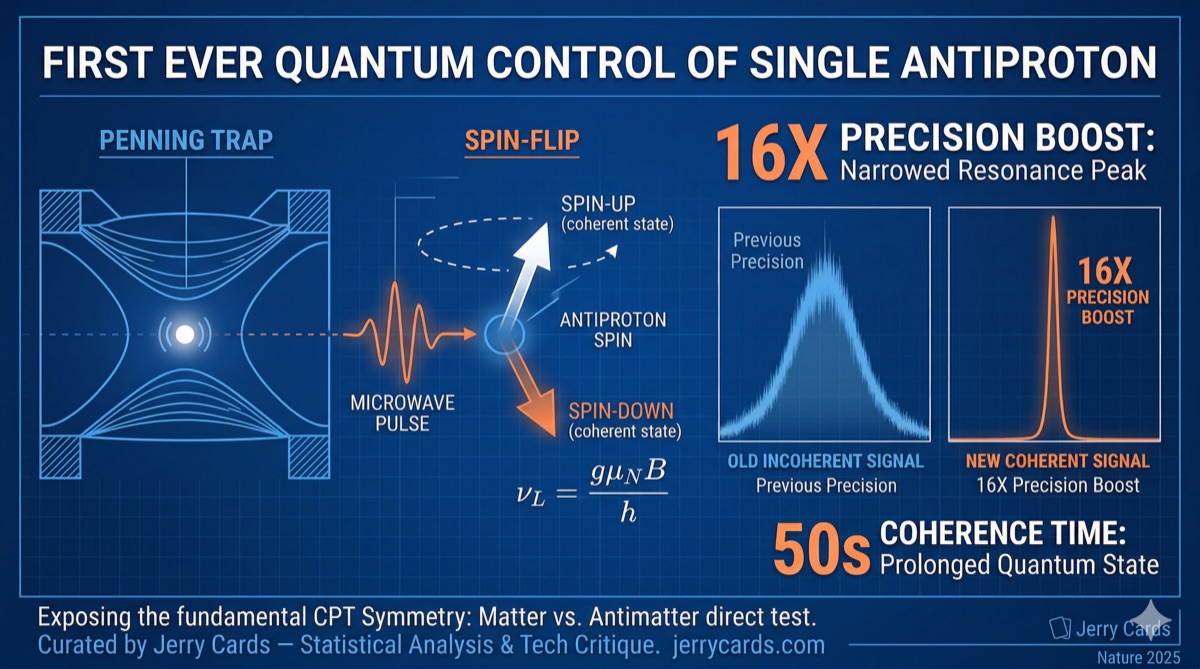
The CERN BASE collaboration has achieved something that was thought to be decades away: full quantum control over a single antiproton. Published in Nature (Volume 644, Pages 64–68), this breakthrough creates the first antimatter qubit and opens the door to the most precise tests of fundamental physics ever attempted.
What They Actually Did
A single antiproton — a particle of antimatter that annihilates on contact with any normal matter — was suspended in a Penning trap: an electromagnetic "bottle" cooled to near absolute zero at CERN’s Antimatter Factory.
The team then performed something called coherent spin spectroscopy. In simple terms: they made the antiproton’s spin flip back and forth between "up" and "down" states in a controlled, predictable way — exactly like a qubit in a quantum computer.
What is "spin"? Every particle has an intrinsic angular momentum called spin. Think of it as a tiny compass needle that can point either "up" or "down." In quantum mechanics, a particle can be in both states simultaneously (superposition) — which is the basis of quantum computing.
The Numbers
| Coherence Time | 50 seconds — the antiproton maintained quantum superposition for nearly a minute |
| Precision Boost | 16x — the resonance peak was narrowed by a factor of 16 compared to previous incoherent methods |
| Future Precision | 10–100x further improvement now within reach, enabling part-per-billion measurements |
| Technique | Coherent Rabi oscillations in a cryogenic Penning trap with suppressed decoherence |
Why Does This Matter? (The Big Picture)
This is not "just" a physics experiment. It’s a test of why the universe exists.
The Problem: The Big Bang should have created equal amounts of matter and antimatter. When they meet, they annihilate each other completely. So the universe should be... nothing. Just radiation. No stars, no planets, no you.
The Mystery: Something made matter "win" by the tiniest margin. The Standard Model’s CPT Symmetry says matter and antimatter must be perfectly identical in every measurable way. If BASE finds even a billionth of a difference in the antiproton’s magnetic moment compared to the proton’s, it would break CPT symmetry — and point to entirely new physics that explains why we exist.
Before vs. After: What Changed
Previous measurements used incoherent spectroscopy — essentially blasting the antiproton with microwave radiation and watching what happened. The signal was broad, fuzzy, and limited in precision.
The breakthrough was achieving coherent spectroscopy: precisely timed microwave pulses that drive the spin through controlled rotations (Rabi oscillations). The result is a razor-sharp resonance peak instead of a broad bump.
Think of it like the difference between banging on a piano with your fist (incoherent) versus pressing a single key with perfect timing (coherent). Both produce sound, but only one tells you the exact frequency.
What Comes Next
- BASE-STEP: The collaboration is building a transportable antiproton trap to move antiprotons from CERN to a quieter laboratory in Düsseldorf, where magnetic field noise is 100x lower. This could push precision to unprecedented levels.
- Antimatter Gravity: CERN’s ALPHA-g experiment is simultaneously testing whether antimatter falls "up" or "down" — another CPT test from a different angle.
- The Ultimate Goal: Measure the antiproton magnetic moment to the same precision as the proton’s (currently known to 0.3 parts per billion). If they differ, physics textbooks get rewritten.
The Bottom Line
For the first time, a particle of antimatter has been turned into a fully controlled quantum system. This isn’t just a technical achievement — it’s the opening move in a precision campaign to answer the deepest question in physics: why does the universe exist instead of nothing?
Sources: Nature: Coherent spectroscopy with a single antiproton spin, CERN News, BASE Experiment