
 العربية
 Español
 中文
中文 Deutsch
 Français
 Português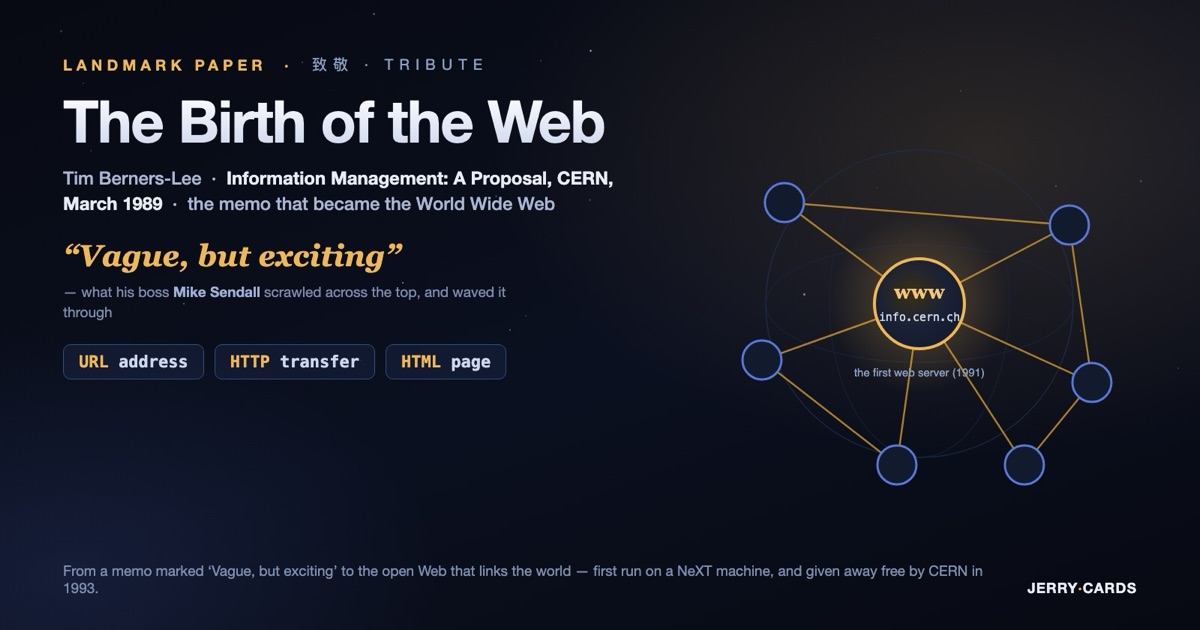
Every link you click today began with a memo that one manager thought was, in his own words, ‘vague, but exciting.’ In March 1989, a 33-year-old software engineer at CERN - the European particle-physics lab near Geneva - handed his supervisor a modest proposal for organizing information. His boss did not fund a grand project or convene a committee. He scrawled two words across the top of the page and let the young man tinker. Those two words, and that tinkering, produced the World Wide Web: the single most widely used piece of software ever created, and one of the very few world-changing technologies that its makers chose to give away for free.
- The document: Information Management: A Proposal, by Tim Berners-Lee, March 1989, at CERN
- The verdict: supervisor Mike Sendall wrote ‘Vague, but exciting’ on the cover and approved the time to build it
- The three inventions: the URL (address), HTTP (transfer), and HTML (page format)
- The first build: browser and server written on a NeXT computer by Christmas 1990
- The first website: info.cern.ch, live on August 6, 1991
- The gift: on April 30, 1993, CERN put the Web software in the public domain, royalty-free
1. A Problem Called ‘Lost Information’
By the late 1980s, CERN was one of the largest research hubs on Earth: thousands of scientists from dozens of institutions, cycling in and out, each bringing their own computers, their own software, and their own way of filing things. Knowledge lived in people’s heads and on incompatible machines, and when a researcher left, their corner of the institution’s memory often left with them. Berners-Lee, who had already built a personal note-linking program years earlier, saw the deeper pattern: the problem was not storage but connection. What if any document could point directly at any other, no matter which computer or program it lived on?
His answer was a system of hypertext - text containing links you could follow - spread across a network. He sketched CERN’s tangle of people, machines, and documents as bubbles joined by arrows, and proposed a ‘web’ that would let anyone navigate from one to the next. The proposal was deliberately open-ended, which is exactly why Sendall’s famous note - ‘Vague, but exciting’ - was so apt. It was vague because Berners-Lee was describing not a product but a universal principle. And it was exciting for the same reason.
2. Internet vs. Web: The Difference That Confuses Everyone
The internet is the plumbing - a global network of networks, built in the 1970s on the TCP/IP protocols, that moves packets of data between machines. The World Wide Web is something that runs on top of that plumbing: a vast collection of documents, linked by hypertext, that you read through a browser. The internet had existed for years before 1989. Berners-Lee’s genius was to build, on top of it, a human-friendly layer that anyone - not just network engineers - could use. The internet is the roads; the Web is the city that grew along them.
3. Three Ideas That Still Run the Internet
What makes the Web endure is how little of it there is. Berners-Lee resisted the urge to build something complicated. He created just three pieces, each doing one job, and they remain the load-bearing walls of the entire web today.
| Invention | What it is | You use it as |
|---|---|---|
| URL | A universal address for any resource on the Web | the jerrycards.com in your address bar |
| HTTP | The protocol browsers and servers use to request and send pages | the https:// prefix on every link |
| HTML | The markup language every page is written in | the headings, links and images on this page |
Any browser that speaks HTTP can fetch any page written in HTML, addressed by a URL, from any server on Earth. That universality - not any single clever trick - is the whole invention.
4. Built on a Black Cube From Steve Jobs
To turn the proposal into working software, Berners-Lee chose a NeXT Computer - the sleek, jet-black machine built by the company Steve Jobs founded after leaving Apple in 1985. Its advanced development tools let one person do in months what might otherwise have taken a team years. By Christmas 1990, he had written two programs on it: the first web browser (called, simply, WorldWideWeb, and unlike today’s browsers it could also edit pages) and the first web server. He was joined by CERN engineer Robert Cailliau, who had co-signed a formal proposal in November 1990 and became the Web’s tireless champion inside the lab.
In 1997, Apple acquired NeXT, and its operating system became the foundation of Mac OS X - and, in time, of macOS, iOS, iPadOS, and the iPhone. The World Wide Web was born on the direct ancestor of the device most people now use to browse it.
5. August 6, 1991: The First Website Goes Live
On August 6, 1991, Berners-Lee published the world’s first website at the address http://info.cern.ch/hypertext/WWW/TheProject.html. It was, fittingly, a page explaining what the Web was and how to make your own. That same day he posted a short public message to the alt.hypertext newsgroup, inviting strangers on the internet to try it - one of the first times a URL appeared in a public post. For a while the Web lived on a single NeXT machine at CERN, watched over by a now-legendary handwritten label reading ‘This machine is a server. DO NOT POWER IT DOWN.’ On August 23, 1991 - a date some now mark as ‘Internaut Day’ - the first visitor from outside CERN loaded the page, and the Web began to spread.
6. The Decision That Made the Web the Web
Here is the part that could easily have gone another way - and changed everything if it had. A company holding this invention might have patented it, licensed it, and charged for every server and browser. Instead, on April 30, 1993, CERN signed a document placing the Web’s software into the public domain. The lab relinquished all intellectual-property rights and gave everyone permission to use, copy, modify, and distribute the code, free of charge and free of royalties.
“CERN’s decision to make the Web foundations and protocols available on a royalty-free basis, and without additional impediments, was crucial to the Web’s existence.”
— Tim Berners-Lee
Because no one owned it, everyone could build on it. Anyone could write a browser, run a server, or publish a page without asking permission or paying a toll. That openness is why the Web outgrew every walled-garden rival of its era. Later that year, the graphical Mosaic browser out of the University of Illinois put images and pages in front of ordinary people, and the Web’s growth turned vertical. In 1994, Berners-Lee founded the World Wide Web Consortium (W3C) at MIT to keep its standards open and shared - a role it still plays.
Why It Still Matters
It is difficult to name another technology of comparable reach that was handed to humanity, deliberately, at no cost. The Web did not become universal in spite of being free; it became universal because it was free and open. Berners-Lee never grew rich from it, and has spent the decades since arguing that the Web should stay a common good - open, accessible, and owned by no one. Every online store, every classroom halfway around the world, every video call with family, every page like this one descends from a short document a manager once found a little vague, but exciting - and from the quiet decision, four years later, to give it all away.
Sources
- CERN: The birth of the Web · Web@30: the anniversary of an invention that changed the world
- The restored first website (primary source): info.cern.ch – The World Wide Web project
- W3C: 30th anniversary of licensing the Web for general use and at no cost (public-domain release, 30 April 1993) · History.com: The world’s first website
- Wikipedia: World Wide Web · Wikipedia: WorldWideWeb (the first browser)
Curated by Jerry Cards - jerrycards.com. We research the milestones behind the tech, science, and business news you use every day so you don’t have to. More at jerrycards.com/news.