
 العربية
 Español
 中文
中文 Deutsch
 Français
 Português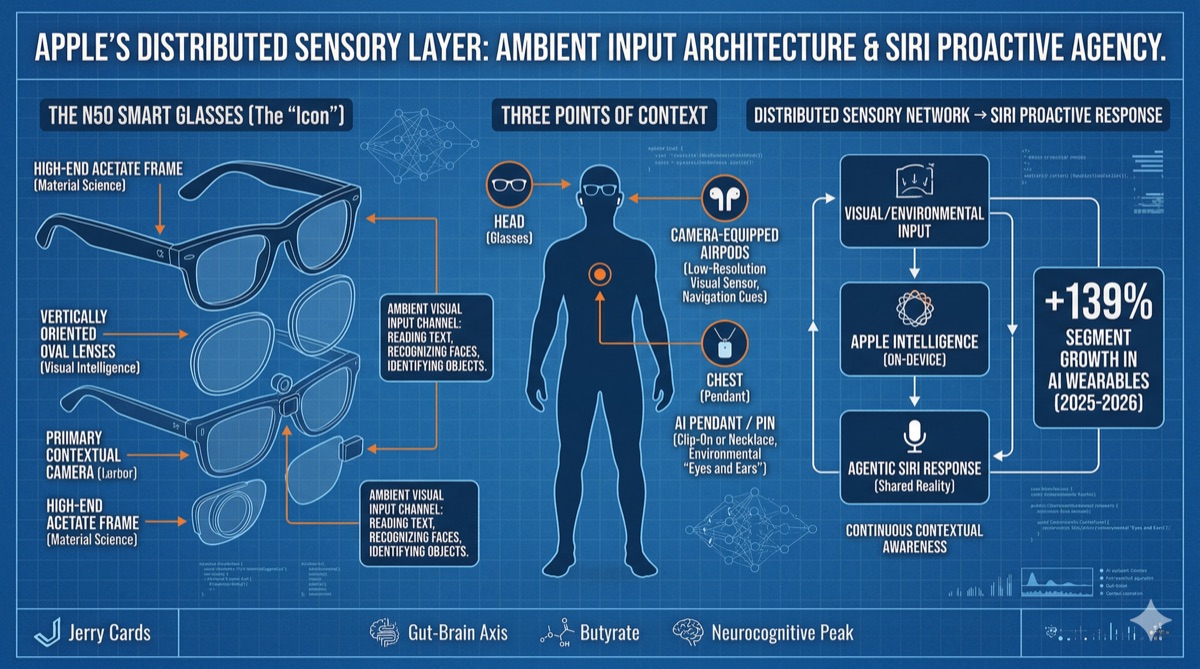
While the industry focused on Apple’s massive March hardware drops (9 products in 3 weeks), new reporting from Bloomberg’s Mark Gurman (April 12–13, 2026) reveals something far more significant: Apple is accelerating its N50 Project — a three-pronged AI wearable strategy designed to give Siri eyes and ears in the physical world.
This isn’t about competing with Meta’s Ray-Ban smart glasses. It’s about building a Distributed Sensory Network that feeds real-time visual and environmental context into Apple Intelligence.
1. The N50 Smart Glasses: "The Icon"
1.1 Design and Materials
Apple is making a deliberate statement with the N50’s build quality. Rather than using standard plastics (as Meta does with Ray-Ban), Apple has opted for high-end acetate — a material known for being more durable, lightweight, and premium than injection-molded plastic. Acetate is what luxury eyewear brands (Oliver Peoples, Moscot, Tom Ford) use for their flagship frames.
| Feature | Detail |
| Material | Acetate — premium, durable, lightweight. A deliberate luxury positioning. |
| Frame Styles (4 tested) | 1. Large rectangular (Wayfarer-style) 2. Slim rectangular (Tim Cook’s signature look) 3. Circular 4. Oval |
| Colors | Black, ocean blue, light brown (more expected) |
| Camera System | Vertically oriented oval lenses with surrounding indicator lights — a departure from Meta’s circular design |
| Core Functions | Visual Intelligence (text reading, object recognition, face identification), photo/video capture, notification relay, music playback, Siri interaction |
| Timeline | Unveil late 2026 or early 2027; ship 2027 |
1.2 Not AR — Visual Intelligence
A critical distinction: the N50 is not an AR headset. There are no holographic overlays or spatial computing features (that’s Vision Pro’s territory). Instead, the glasses focus entirely on Visual Intelligence — using cameras and sensors to understand what you’re looking at and feeding that context to Siri.
The Use Cases: You look at a restaurant menu in French → Siri translates it in your AirPods. You look at a broken circuit board → Siri identifies the component and suggests a replacement. You walk into a meeting → Siri recognizes the attendees from your contacts and whispers relevant context into your ear. This is ambient intelligence, not augmented reality.
2. The AI Pendant: "Eyes and Ears" Without Glasses
For users who don’t want to wear smart glasses, Apple is developing a second form factor: a small, clip-on or necklace-style AI pendant.
| Form Factor | Roughly AirTag-sized; pin or necklace attachment |
| Sensors | Built-in camera for ambient visual context |
| Function | Acts as a secondary "eye" for the iPhone, providing environmental awareness to Siri without requiring glasses |
| Positioning | iPhone accessory (not standalone) — all processing happens on the phone or Apple’s Private Cloud Compute |
This is Apple’s answer to the Humane AI Pin — but positioned as a companion device to the iPhone rather than a standalone product. The key lesson Apple learned from Humane’s failure: the pendant doesn’t need to replace your phone; it needs to extend your phone’s senses.
3. Camera-Equipped AirPods
The third prong of the sensory layer is already in advanced testing: AirPods with integrated cameras.
- Low-resolution sensors: Not designed for photography, but for AI context (gesture recognition, environmental mapping, sign reading)
- Real-time assistance: Navigation cues whispered in your ear, live translation of overhead signs, identification of objects you’re looking toward
- Timeline: Could launch as early as late 2026
4. The Architectural Insight: Three Points of Context
What makes Apple’s approach different from competitors (Meta, Google, Humane) is the multi-point distribution:
| Sensor Point | Device | Data Captured | Siri Use Case |
| Head | N50 Glasses | Full visual field, text, faces, objects | "What am I looking at?" → identification, translation, context |
| Ears | Camera AirPods | Directional audio, peripheral vision, gestures | Navigation cues, hands-free interaction, sign reading |
| Chest | AI Pendant | Ambient visual context, environmental awareness | Proactive suggestions without wearing glasses |
All three feed into the same pipeline: Visual Input → Apple Intelligence (on-device + Private Cloud Compute) → Agentic Siri Response. The iPhone remains the compute hub; the wearables are the distributed sensors.
5. From Reactive to Proactive: The Paradigm Shift
Current Siri (Reactive): You pull out your phone, open an app, type or speak a question. Siri responds to your explicit request. No visual context. No environmental awareness.
Ambient Siri (Proactive): Your glasses see you’re approaching a foreign-language sign. Your AirPods detect you’ve slowed down. Siri proactively reads and translates the sign into your ear — without you asking. The AI sees you are lost and offers a map. It sees you’re in a meeting and surfaces the relevant agenda from your calendar.
This is the transition from Reactive AI (you initiate every interaction) to Proactive Agency (the AI perceives your environment and acts when appropriate). It’s the same paradigm shift we analyzed in the Claude Code KAIROS system (Part 3 of our Architecture of Agency series) — but applied to hardware instead of software.
6. The WWDC 2026 Connection
All three wearable devices are being designed around the major Siri overhaul expected at WWDC 2026 (June 8). The revamped Siri (codenamed "Campos") will feature:
- Standalone chatbot app with conversational interface
- Deep on-screen awareness across all apps
- Powered by a custom 1.2-trillion-parameter Google Gemini model
- Running on Apple’s Private Cloud Compute infrastructure
The N50 glasses, AI pendant, and camera AirPods are the hardware delivery mechanism for this new Siri. The software ships at WWDC; the hardware ships over the following 12 months.
7. The Competitive Landscape
| Company | Product | Approach |
| Meta | Ray-Ban Meta Glasses | Social-first: photos, livestreaming, Meta AI assistant. Plastic frames. |
| Project Astra / Gemini | Camera-first: real-time visual understanding via phone camera. No dedicated glasses yet. | |
| Humane | AI Pin (discontinued) | Standalone pendant. Failed due to lack of phone integration and poor UX. |
| Apple | N50 + Pendant + AirPods | Distributed sensory layer. Premium materials. iPhone as compute hub. Privacy-first processing. |
Apple’s differentiation: multi-device sensor fusion (not a single product), premium materials (acetate, not plastic), and privacy-first processing (on-device + Private Cloud Compute, not cloud-dependent).
The Bottom Line
The iPhone isn’t dying. It’s evolving from a device you look at to a device that looks for you. The N50 glasses, AI pendant, and camera AirPods are the sensory organs; the iPhone is the brain; and Siri is graduating from a voice assistant to an ambient agent that exists in the space around you.
We are entering the era of Ambient Intelligence — where AI doesn’t live behind a screen, but in the air around you.
Sources: